A marketer can create the same piece of content, publish it on LinkedIn, Reddit, YouTube and a brand website – and get four completely different outcomes.
Not because the content suddenly became good or bad.
Because the audience changed, the context changed, and the psychology of the channel changed.
This is something marketers often learn the hard way.
- What works on LinkedIn may feel self-promotional on Reddit.
- What works on Reddit may feel too casual on a brand website.
- What works in Google Search may not work in YouTube.
- And what works everywhere else may not even be enough when the audience starts asking AI platforms for the answer.
The channel is not just a distribution mechanism. It shapes how people discover, evaluate and respond to information.
That is why, before asking “What should we post?”, marketers should first ask:
“How do people behave here?”
A good idea can fail simply because it speaks the wrong channel language
Imagine a company has just achieved a major milestone.
On LinkedIn, the natural approach might be to say:
“We are delighted to announce that we have achieved a 40% increase in organic visibility, marking another important milestone for our team.”
That kind of communication makes sense on LinkedIn. People expect professional achievements, expertise, leadership updates and business milestones.
Now post the same thing on Reddit.
It may immediately feel like advertising.
Reddit users often value personal experience, transparency, usefulness and authenticity over polished corporate messaging. The same “40% growth” can mean very little unless you explain what actually changed, what you learned, or what someone else can take away from it.
The fact has not changed.
The acceptable way of presenting the fact has changed.
That is Channel Psychology.
What is “Channel Psychology”?
Channel psychology is simply understanding:
Why are people here?
What do they expect?
What do they trust?
What makes them engage?
What makes them switch off?
In short, it means understanding the mindset, expectations and behaviours people bring to each platform – before you decide what to say on it.
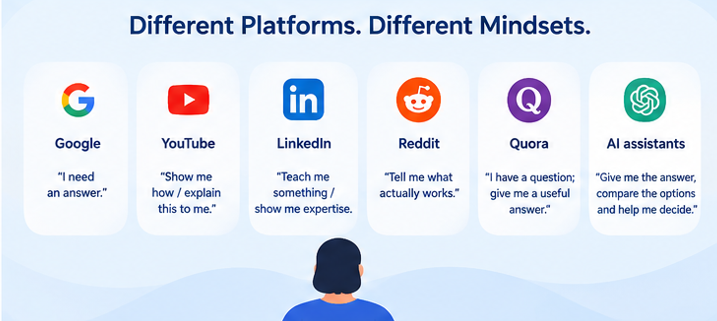
Think about the mindset of a person opening different platforms.
For example:
| Channel | Objective |
|---|---|
| “I need an answer.” | |
| YouTube | “Show me how / explain this to me.” |
| “Teach me something / show me expertise / tell me what is happening in the industry.” | |
| “Tell me what actually works.” | |
| Quora | “I have a question; give me a useful answer.” |
| AI assistants | “Give me the answer, compare the options and help me decide.” |
These aren’t hard rules. But they reveal something important:
The same user can behave like a different person depending on where you meet them.
And that should change the strategy.
Reddit taught SEO a useful lesson
There is an interesting parallel with SEO itself.
A marketer used to Google might naturally think:
Find the keyword → create the content → optimise the page → build authority → rank.
Take that mindset to Reddit and it can fail.
Reddit is not simply another search engine.
People are not necessarily looking for the most polished article or the most optimised answer. They may be looking for experience, honesty, proof, debate or a real person’s perspective.
That changes the content.
Instead of:
“Here are 7 reasons our solution is the best.”
The more natural contribution might be:
“I tried three options. Here’s what worked, what didn’t, and what I wish I knew before starting.”
The topic may be identical.
The psychology is different.
And therefore the strategy is different.
LinkedIn has its own psychology too
LinkedIn rewards a different kind of behaviour.
Professional credibility matters. So do expertise, perspective, relevance and professional identity.
But there is a subtle difference between showing expertise and trying to look impressive.
For example:
Channel-native:
“We tested this approach across 12 pages. Here are the three things that changed our results.”
Less channel-native:
“Thrilled to announce another incredible SEO success story as we continue to redefine digital
excellence.”
Both communicate success.
But the first one gives the audience something to learn.
That’s the point.
A channel isn’t just asking:
“What are you saying?”
It is also asking:
“Why should I care?”
YouTube isn’t a blog with a play button
This is another common mistake.
A marketer may take a 1,500-word article and turn it into a 10-minute video without changing the thinking.
But YouTube has a different psychology.
People want:
- Demonstration
- Explanation
- Visual proof
- Storytelling
- Progression
- A reason to keep watching
A good YouTube strategy therefore thinks beyond keywords.
It asks:
What will make someone stop scrolling?
What will make them continue watching?
What will make them feel the video was worth their time?
That is why “SEO for YouTube” and “SEO for Google” cannot simply be treated as the same exercise.
The optimisation may overlap.
The user psychology does not.
Don’t repurpose content. Reinterpret the insight
One of the biggest mistakes in multi-channel marketing is treating content repurposing as a simple formatting exercise.
A blog becomes a LinkedIn post. The same blog becomes a Reddit post. Then it becomes a YouTube video. Then perhaps a carousel.
The format changes.
The thinking doesn’t.
But channel psychology tells us that it should.
A strong idea can travel across channels. The way we communicate that idea shouldn’t necessarily remain the same.
| Traditional Repurposing | Channel-Native Approach |
|---|---|
| One blog → multiple platforms | One insight → multiple executions |
| Same message, different formats | Same idea, different context |
| Format-led | Audience-led |
| Distribution-focused | Behaviour-focused |
| Maximise content output | Maximise content relevance |
The goal shouldn’t be to make one piece of content work everywhere.
It should be to make one valuable idea relevant everywhere.
And then came AI
AI makes this even more interesting.
Traditional digital marketing often worked around a relatively simple journey:
Discover → Click → Read → Act
AI introduces another possibility:
Ask → Receive → Compare → Decide
A user may never visit ten websites.
They may ask:
“Which health insurance is best for a family of four?”
or:
“Which bank is best for NRI banking in India?”
or:
“Compare these three mutual fund options.”
Now the marketer isn’t only trying to win the click.
The brand needs to be:
- understood correctly,
- associated with the right topic,
- considered credible,
- surfaced in the answer,
- and potentially cited as a source.
This is where SEO and GEO intersect – but they are not identical.
SEO helps a brand become discoverable.
GEO increasingly asks whether that brand can become part of the answer.
One audience. Multiple mindsets.
The interesting part is that these channels don’t operate independently.
A person might:
Search on Google → watch a YouTube review → read Reddit opinions → check LinkedIn for credibility → ask ChatGPT to compare the options → visit the website to convert.
The customer journey is becoming multimodal.
That means a brand cannot assume that one content strategy can simply be copied across every platform.
Instead, we need to think:
What role does this channel play in the decision?
Here’s the Channel Role Framework in action – the role each channel plays in getting someone from curiosity to a decision:
- Google may help someone discover.
- YouTube may help them understand.
- Reddit may help them validate.
- LinkedIn may help them trust the expertise.
- AI may help them make the decision.
- The website may help them take action.
Suddenly, the channels stop looking like separate marketing activities.
They become different stages of the same conversation.
So what should marketers do differently?
Before creating content for any channel, ask five simple questions:
1. Why is the user here?
Are they searching, learning, validating, comparing or deciding?
2. What does this audience trust?
Data? Experts? Personal experience? Reviews? Demonstrations?
3. What feels native here?
A corporate announcement, a detailed answer, a video, a discussion or a comparison?
4. What behaviour does the platform reward?
Clicks? Watch time? Engagement? Helpful answers? Citations?
5. What is our role in this conversation?
Are we trying to educate, influence, reassure or convert?
Once those questions are answered, the strategy becomes much clearer.
The future is not about choosing one channel
For years, marketers asked:
SEO or social?
Then:
Search or video?
Now:
Website or AI?
That may be the wrong question.
Here’s a simpler way to frame it – call it the Channel Role Framework: instead of ranking channels against each other, ask what job each one is doing in a person’s decision. A channel isn’t competing with another channel for the win. It’s playing a different part in the same story.
The future is increasingly about understanding how different channels work together.
A marketer who understands only SEO may know how to rank a page.
A marketer who understands only social may know how to generate engagement.
But a stronger marketer understands how people think differently at each touchpoint – and adapts the message accordingly.
That is the real advantage.
When NOT to Use a Channel
Channel psychology isn’t only about knowing where to show up. It’s equally about knowing where not to. Forcing a message onto a channel that was never built for it usually does more damage than staying off it altogether.
- Don’t use Reddit for polished announcements or hard selling. A corporate tone reads as an ad the moment it appears in a Reddit thread – and Reddit communities are quick to call it out.
- Don’t use LinkedIn for humour-first or controversial content. A professional audience is there to learn and network, not to be entertained – that content finds a better home on Instagram or X.
- Don’t force a topic onto YouTube if it has nothing to demonstrate.. A video that’s just someone reading a blog aloud wastes production effort; a written guide serves the reader better.
- Don’t lean on AI/GEO-first content for emotional brand storytelling.. GEO is built for factual, comparison-style questions – narratives still need channels built for narrative, like video and social.
- Don’t use Quora for real-time or trending topics. Quora rewards evergreen depth, not speed – fast-moving news belongs on faster-moving channels.
- Don’t try to put every message on every channel. If an idea doesn’t fit a channel’s psychology, skipping that channel is often the smarter, more credible choice.
Stop Thinking Channel-First. Start Thinking User-First
The biggest mistake in multi-channel marketing is not using the wrong platform.
It is using the right platform with the wrong mindset.
The next generation of digital marketing will not simply belong to people who know how to optimise for Google, Reddit, LinkedIn, YouTube or AI.
It will belong to people who understand why users behave differently on each of them.
Because channels may change.
Algorithms may change.
Formats may change.
But one thing remains constant:
Before you optimise the channel, understand the person on the other side of it.
| Channel | User mindset | What they value | Brand role |
|---|---|---|---|
| I need an answer | Relevance | Answer | |
| YouTube | Show me | Demonstration | Educate |
| What actually works? |
Experience | Participate | |
| Show me expertise | Credibility | Teach | |
| AI | Help me decide | Clarity + authority | Become a source |
| Website | I’m ready to act | Confidence | Convert |
And perhaps that is the most important shift marketers need to make in the AI era.
The channels will continue to evolve. New platforms will emerge, algorithms will change and the way people discover information will keep shifting.
But the fundamental question remains the same: “Why is the user here, and what do they expect from us?”
At LS Digital, we bring this user-first thinking across SEO, Content, Social, Performance, UX and AI Search/GEO – helping brands adapt their strategy to how people actually discover, evaluate and make decisions across the digital ecosystem.
Because the future of digital marketing isn’t about being present on every channel. It’s about understanding the person behind every channel – and showing up the way they expect you to.
That’s channel psychology. And it’s the thinking that will separate brands who are simply visible from brands who are truly heard.
*******
Author bio:

Gaurav, a Senior SEO Specialist at LS Digital, where he works at the intersection of search strategy and data-driven insight to help brands grow their organic visibility. A MICA alumnus based in Mumbai, his work spans classic SEO to the emerging world of GEO and AI search visibility, and has contributed to award-winning, high-growth campaigns across sectors including BFSI and higher education. He writes about how search, content and platform behaviour are evolving together in the AI era.