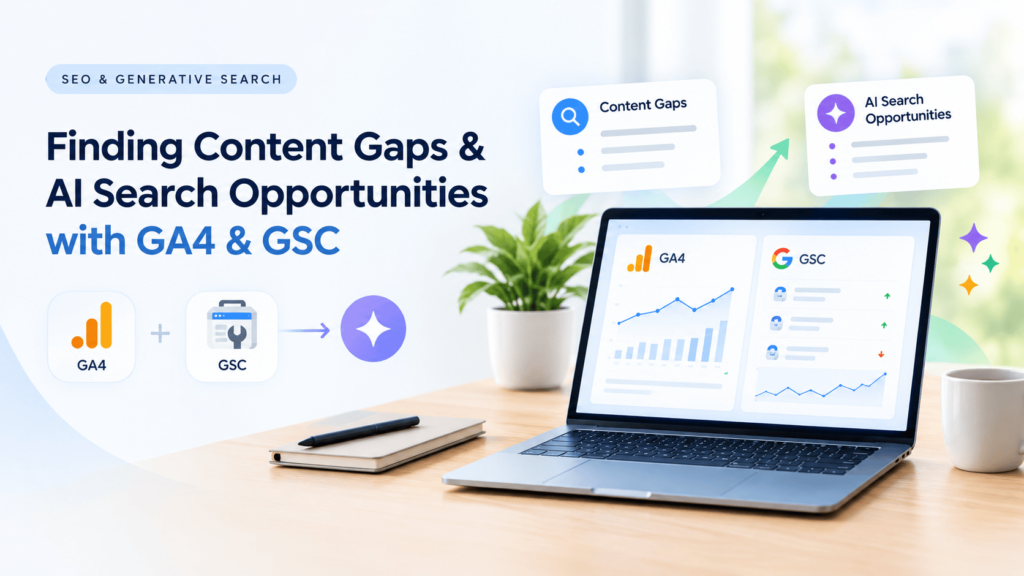
Search behavior is changing. Users are no longer relying only on traditional Google results to discover information. They increasingly turn to AI-powered search experiences such as Google AI Overviews, ChatGPT, Gemini, and other generative search platforms for quick, conversational answers.
For brands, this creates a new opportunity: identify what users are searching for, understand where existing content falls short, and create content that can perform across both traditional search and AI-driven discovery.
Two of the most valuable sources for uncovering these opportunities are Google Analytics 4 (GA4) and Google Search Console (GSC). Used together, they can reveal content gaps, user intent, underperforming pages, and topics where your brand has an opportunity to build greater search visibility.
What Is a Content Gap?
A content gap exists when your website does not adequately address a topic, question, or search intent that matters to your audience.
A gap can occur in several ways:
- Your competitors cover a topic that you do not.
- You rank for a keyword but do not fully answer the user’s question.
- Your page receives impressions but few clicks.
- Users arrive on your page but leave without exploring further.
- Your content addresses a broad topic but misses specific questions.
- Your website lacks content that supports users at different stages of the buying journey.
For AI search, content gaps can be even more important because generative engines often need clear, comprehensive, and context-rich information to understand whether a brand is relevant to a particular query.
How GA4 Helps Identify Content Gaps
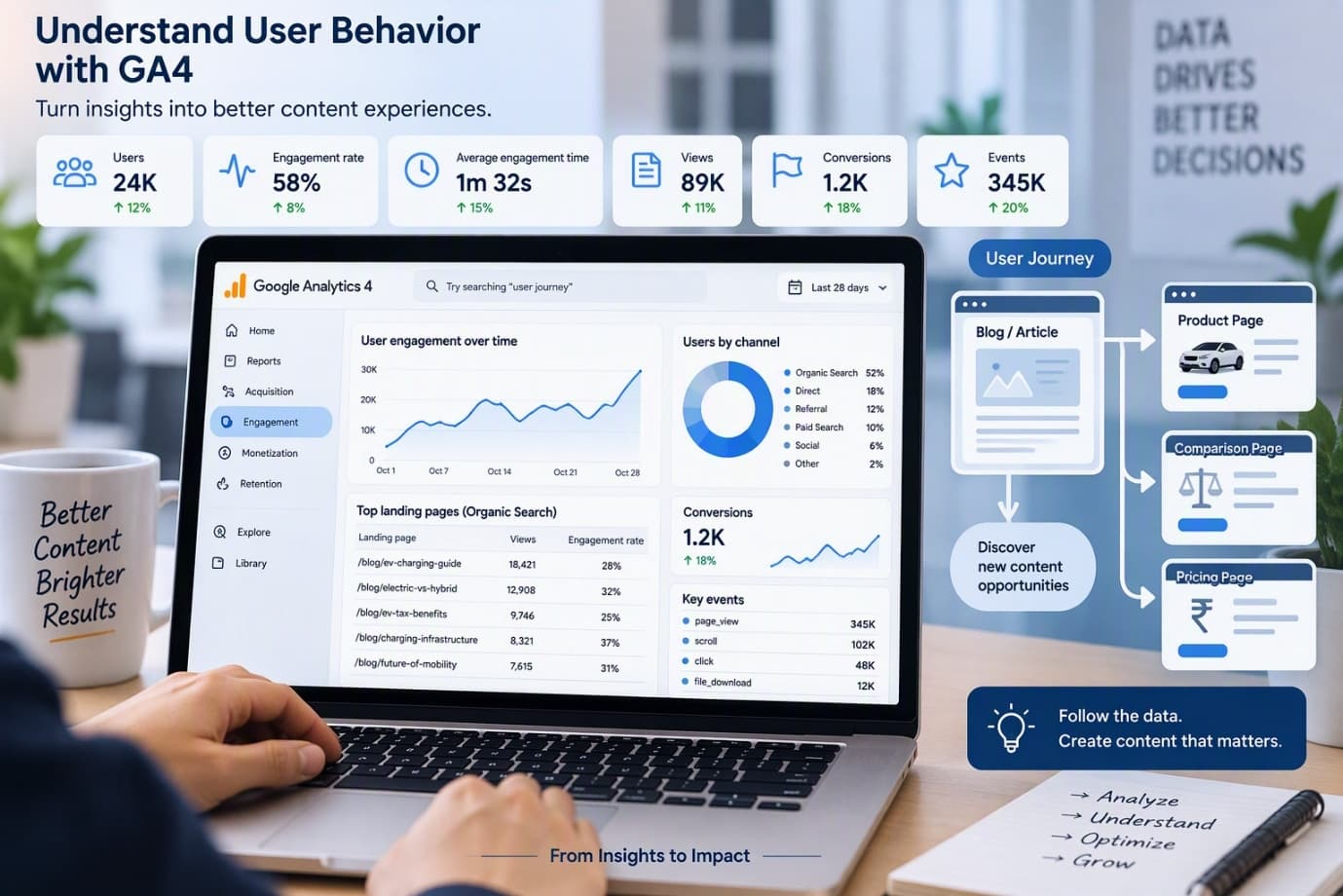
GA4 provides behavioral data that helps you understand what happens after users reach your website.
Start by identifying pages that attract organic visitors but generate weak engagement. A page may receive search traffic but fail to satisfy users because the content does not match their intent.
Look at metrics such as:
- Engagement rate
- Average engagement time
- Landing pages
- Views
- User journeys
- Conversions
- Events and interactions
For example, if an informational article consistently attracts organic users but has low engagement, investigate whether the page answers the query sufficiently. It may need clearer explanations, additional FAQs, comparison information, examples, visuals, or stronger internal links.
GA4 can also help uncover secondary content opportunities. Analyze what users do after landing on an article. If visitors frequently move from an informational page to a product, service, comparison, or pricing page, that journey can reveal topics worth developing into dedicated content.
How Google Search Console Reveals Search Opportunities
GSC provides another layer of insight by showing how your website performs in Google Search.
Focus on:
- Queries
- Impressions
- Clicks
- CTR
- Average position
- Pages receiving search visibility
One of the strongest content-gap signals is a page receiving high impressions but relatively low clicks.
This can indicate that your page is visible for relevant searches but does not have a compelling enough title or does not sufficiently match search intent.
Another useful opportunity is identifying queries where a page ranks around positions 5-20. These queries represent topics where your content already has some relevance but may require improvement to compete more effectively.
Review the actual queries associated with those pages. You may discover questions or subtopics that are not adequately covered in the existing content.
Turning GSC Data Into Content Gaps
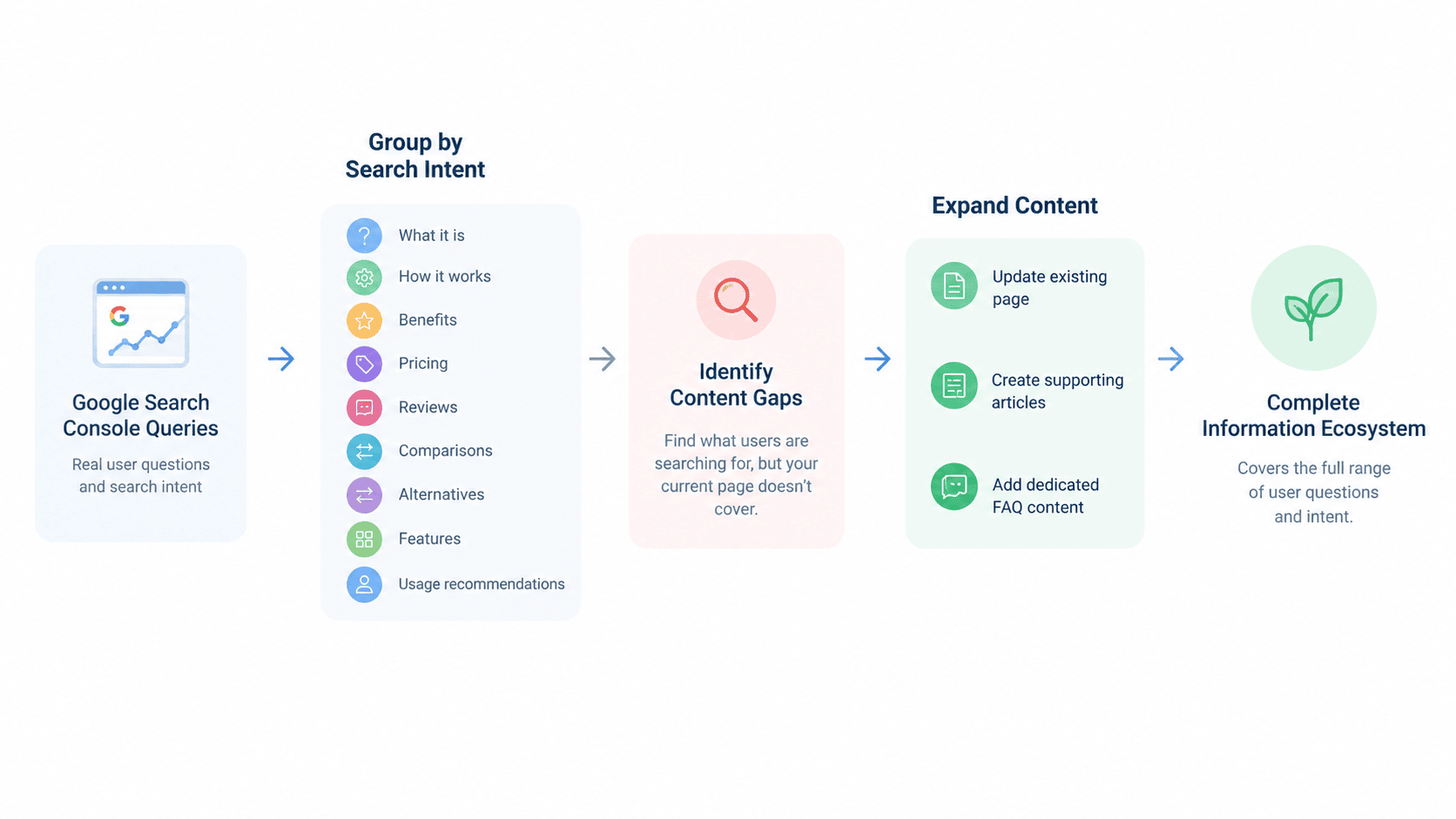
Instead of looking at keywords individually, group GSC queries by search intent and topic.
For example, a page about a product or service may generate queries around:
- What it is
- How it works
- Benefits
- Pricing
- Reviews
- Comparisons
- Alternatives
- Features
- Usage recommendations
If your existing page primarily discusses benefits but users are searching for pricing, comparisons, alternatives, reviews, or implementation guidance, these represent potential content gaps.
You can address them by expanding the existing page, creating supporting articles, or developing dedicated FAQ content.
For example, a page may be generating strong impressions for keywords such as cost, pricing, benefits, alternatives, reviews, how to use, or best options. However, if the page primarily focuses on a product or service overview, these query themes may indicate content gaps. Rather than treating each keyword independently, businesses can expand content with practical guidance, FAQs, comparisons, use cases, expert insights, or supporting resources. This creates a more comprehensive experience that addresses the broader range of user questions and intent associated with the topic.
The goal is not simply to add more keywords. It is to create a more complete information ecosystem around the topic.
Finding AI Search Opportunities
Traditional SEO data can also be used to identify potential opportunities for AI search visibility.
AI-powered search experiences tend to favor content that clearly addresses questions and provides useful, contextual information. Therefore, look for queries that are naturally conversational or question-based.
GSC can help identify searches containing terms such as:
- What
- How
- Why
- Which
- Best
- Difference between
- Benefits
- Risks
- Alternatives
- Cost
Next, evaluate whether your website provides a direct and comprehensive answer.
For AI search optimization, consider creating content structures that make information easy to understand and extract:
- Clear question-based headings
- Concise answers
- Detailed supporting explanations
- FAQs
- Comparison tables
- Original research or data
- Expert perspectives
- First-hand insights
- Relevant statistics
- Clear definitions
- Strong internal linking
This approach helps your content serve both traditional search users and users interacting with AI-powered search.
Combining GA4 and GSC for Better Insights
The real value comes from using GA4 and GSC together.
GSC tells you what users searched for and how your pages performed in search. GA4 helps you understand what users did after reaching your website.
A simple workflow is:
GSC → Identify search queries → Group by intent → Find content gaps → GA4 → Analyze engagement and conversions → Prioritize opportunities → Create or optimize content → Measure results
For example, if GSC shows strong impressions for a question but low CTR, investigate the page’s title, intent alignment, and content depth.
Consider a page that receives substantial impressions in GSC but attracts relatively few clicks. A review of query data may reveal recurring searches related to pricing, features, alternatives, comparisons, reviews, or how-to information that are not adequately addressed on the page. When this insight is combined with GA4 data showing low engagement time, limited interactions, or weak conversion performance, it becomes clearer that the page may not be meeting user expectations.
In this scenario, enriching the content with direct answers, FAQs, comparison sections, practical examples, user-focused explanations, and internal links to supporting resources could improve both search performance and user engagement. Many of these same questions also represent opportunities for AI-powered search platforms, which often favor content that delivers clear, contextual answers to common user queries.
If GA4 then shows poor engagement, the content may require a deeper rewrite rather than simply a title change.
Build a Continuous Content-Gap Process
Content-gap analysis should not be a one-time SEO exercise. Search behavior, competitors, and AI-generated search experiences continue to evolve.
A practical monthly process can include:
-
Export GSC queries and identify emerging topics.
-
Find pages with high impressions but low CTR.
-
Identify keywords ranking between positions 5 and 20.
-
Review GA4 engagement and conversion data.
-
Map queries to user intent.
-
Identify unanswered questions and missing subtopics.
-
Prioritize opportunities based on business value and search potential.
-
Refresh existing content or create new supporting content.
-
Track changes in rankings, clicks, engagement, and conversions.
-
Monitor whether your brand becomes more visible across AI-driven search experiences.
Not every opportunity should be treated equally. For instance, a business may identify three possible initiatives:
- Improving an existing high-impression landing page
- Creating a comparison-focused guide
- Publishing a comprehensive educational resource around a broader topic
The landing page enhancement may be prioritized first because it already has search visibility and commercial intent, allowing improvements to impact clicks, engagement, and conversions more quickly. The comparison guide may come next because it supports users during the evaluation stage of their journey, while the broader educational content can be viewed as a longer-term authority-building opportunity.
Evaluating opportunities through the lens of business relevance, potential impact, and implementation effort helps ensure resources are focused where they can create the greatest value.
Conclusion
GA4 and Google Search Console are more than performance-reporting tools. Together, they can become a powerful framework for discovering what your audience wants, where your content falls short, and where new search opportunities exist.
By combining search-query data from GSC with behavioral insights from GA4, brands can move beyond keyword targeting and build content around real user needs.
As AI-powered search continues to influence how people discover information, the brands that understand user intent, close content gaps, and provide comprehensive, trustworthy answers will be better positioned to earn visibility across both traditional search and emerging AI search experiences.
Author Bio:
Shashi Vishwakarma is a Group Head and SEO expert known for her work in scaling organic visibility. She works on positioning brands as the most reliable answers in today’s AI-powered discovery landscape. Blending strategic insight with practical execution, she brings a future-ready approach to digital growth and innovation.