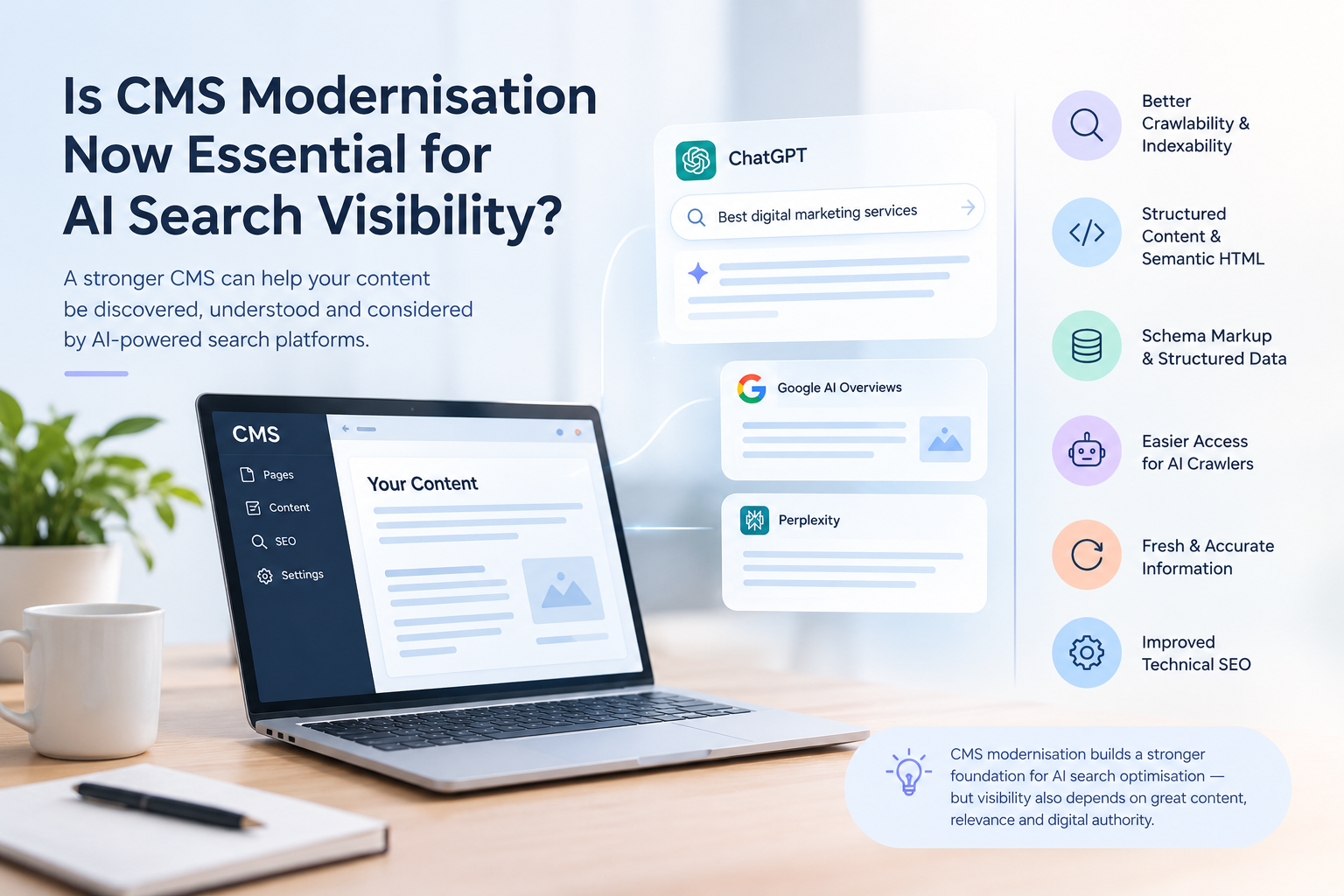
Yes, CMS modernisation is becoming an important consideration for visibility in AI-powered search. Platforms such as ChatGPT, Google AI Overviews and Perplexity may use website content to inform their answers, making technical accessibility, clear content structure and accurate information essential for discoverability. An outdated CMS may create barriers that make content harder to crawl, index or retrieve.
Previously, CMS upgrades focused primarily on website design, publishing efficiency and performance. While these remain important, businesses must now consider whether their websites can effectively support both traditional SEO and Generative Engine Optimisation (GEO).
CMS modernisation can strengthen the technical foundation for AI search optimisation, but upgrading a CMS alone does not guarantee AI visibility or citations. Success also depends on content quality, relevance, digital authority and how individual AI platforms select and present information.
What Is CMS Modernisation and Answer Engine Visibility?
CMS modernisation is the process of upgrading or improving a content management system to meet current website, content, and technical requirements. This may involve updating an existing CMS, changing its architecture, or moving to a new platform.
Answer engine visibility refers to how easily AI-powered platforms can discover, retrieve, and reference a business’s content when responding to user questions.
The relationship between the two is straightforward:
- Content Accessibility: A modern CMS may make website information easier for search and AI crawlers to access.
- Content Structure: Clear headings, organised information, and semantic HTML help systems interpret page content.
- Technical SEO: Improved indexing controls, internal linking, and rendering support better content discovery.
- Content Accuracy: Efficient publishing workflows help businesses keep important information updated.
However, a modern CMS alone does not guarantee AI citations or inclusion in AI-generated answers.
Why Is CMS Modernisation Becoming Important for Answer Engine Visibility?
AI-powered search platforms need accessible and relevant information to generate responses. A CMS plays an important supporting role by determining how website content is organised and delivered.
Here are eight ways CMS modernisation may improve a website’s readiness for AI-powered discovery.
1.Structured Content and Semantic HTML
A page should make it easy to identify what information is important.
Modern CMS platforms can support:
- Clear H1, H2, and H3 heading structures.
- Proper use of HTML elements for different content types.
- Dedicated sections for services, products, and supporting information.
For example, a service page that separately explains its features, benefits, and applications is easier to interpret than one containing large, unstructured paragraphs.
2.Improved Website Crawlability and Indexability
If search engines cannot discover important pages, those pages may struggle to appear in search results.
Modern CMS platforms may provide better control over:
- XML sitemaps and canonical URLs.
- Internal linking and navigation.
- Page indexing and redirect settings.
These features help search engines find content and determine which pages to index.
3.Structured Data and Schema Markup Implementation
Schema markup gives search engines additional information about website content.
For instance, a business can use relevant structured data to identify its organisation, products, articles, or breadcrumbs.
Modern CMS platforms can simplify this process through reusable templates, helping businesses maintain consistency across pages.
While schema markup improves machine-readable context, it does not guarantee AI citations.
4.Content Accessibility for AI Crawlers
Some AI-powered search platforms use crawlers to discover or retrieve website content. However, information may be difficult to access when websites rely heavily on JavaScript, block relevant crawlers or have restrictive security settings.
Businesses should distinguish between two types of crawlers:
- Search discovery crawlers: Help platforms discover, index or retrieve content for search results and AI-generated answers. Examples include Googlebot for Google Search and OAI-SearchBot for ChatGPT Search.
- AI model training crawlers: Collect publicly accessible information that may be used to train AI models. OpenAI’s GPTBot is an example. Allowing training crawlers is not necessarily required for AI search visibility.
A modern CMS can help businesses improve content accessibility through practical checks:
- Review robots.txt: Ensure relevant search crawlers are not unintentionally blocked and manage training crawler permissions separately where supported.
- Check firewall restrictions: Verify that CDN settings, firewalls and bot protection tools are not blocking legitimate search crawlers.
- Improve HTML accessibility: Make important text, headings and internal links accessible without relying entirely on JavaScript execution.
- Test page access: Check that important URLs load correctly, return successful HTTP responses and do not require login access.
These checks can reduce technical barriers to content discovery. However, allowing crawler access does not guarantee that AI platforms will retrieve, mention or cite a website.
5.Content Freshness and Real-Time Updates
Imagine a customer asking an AI platform about a company’s services, only to receive information that is no longer accurate.
Although AI platforms may use older information, keeping website content updated improves its usefulness.
Modern CMS platforms can support:
- Scheduled content reviews.
- Faster updates across multiple pages.
- Content versioning and approval workflows.
This feature is particularly useful for websites with frequently changing products, services, or business information.
6.Website Performance and Core Web Vitals
A website that loads slowly or shifts unexpectedly can create a poor visitor experience.
CMS improvements may support faster page delivery through better caching, optimised images, and efficient rendering.
These improvements can contribute to Core Web Vitals and traditional SEO performance. However, they should not be treated as guaranteed ranking signals for every AI-powered answer platform.
7. Content Architecture and Entity-Based Relationships
A website may have detailed information about its services, but how are those pages connected?
A modern CMS can make it easier to establish relationships between:
- Main service pages and related solutions.
- Industry pages and relevant case studies.
- Educational articles and supporting resources.
This creates a clearer content structure for users and search systems.
8.Scalable Content Management for Multi-Channel Publishing
Businesses often need to publish similar information across websites, apps, and regional platforms.
Modern CMS architectures can support centralised content management, enabling teams to:
- Reuse approved content across different channels.
- Maintain consistent business information.
- Update content without repeating the entire publishing process.
This feature becomes useful as a business expands its digital presence.
How Does CMS Modernisation Influence Visibility Across AI Search Platforms?
CMS modernisation can support AI search visibility by making website content easier to access, organise and maintain. However, different AI search platforms have their own retrieval, ranking and citation mechanisms.
A modern CMS can improve the technical foundation for content discovery, but it cannot control whether a platform includes or cites a particular website.
| AI Search Platform | Relevant CMS Capability | Potential Benefit | Important Limitation |
| Google AI Overviews and AI Mode | Crawlable pages, indexing controls and accessible content | Supports eligibility for discovery through Google Search | Google determines which indexed pages appear as supporting links |
| ChatGPT Search | Accessible HTML and appropriate crawler permissions | Allows permitted search crawlers to access relevant website content | Accessible pages are not guaranteed to appear in AI-generated answers |
| Perplexity | Accessible webpages and clearly organised information | Reduces technical barriers to accessing website information | Perplexity independently determines which sources to reference |
| Microsoft Copilot / Bing | Crawlable pages, indexing controls and structured content | Supports discovery through Bing’s search infrastructure | Indexing does not guarantee selection or citation in Copilot responses |
| Voice Search Interfaces | Clear answers and accessible page content | Supports content interpretation where web search is used | Source selection and attribution vary by device, assistant and underlying search provider |
The key distinction is that technical accessibility supports content discovery, not guaranteed visibility. Each platform applies its own methods to select information and display sources.
For businesses, effective GEO requires more than upgrading CMS technology. Content relevance, accuracy, digital authority and technical accessibility must work together to improve the opportunities for inclusion in AI-generated answers.
Key CMS Capabilities Required for Answer Engine Optimisation
Businesses do not necessarily need the most advanced CMS. They need one that supports their content and search requirements effectively.
| CMS Capability | SEO/AEO Requirement | Expected Benefit |
| Semantic HTML Support | Proper headings and content elements | Clearer interpretation of information |
| Structured Content Fields | Consistent page formats | Better content organisation |
| Schema Markup Management | Relevant structured data | Additional machine-readable context |
| Technical SEO Controls | Canonicals, sitemaps, redirects | Better crawling and indexing control |
| Server-Side Rendering Support | Accessible page content | Fewer rendering-related barriers |
| Internal Linking Management | Connections between related pages | Improved content discovery |
| Content Versioning | Accurate and regularly reviewed information | Better publishing governance |
| API Integrations | Flexible content delivery | More efficient multi-channel publishing |
These capabilities provide a practical foundation for AI search optimisation, but their value depends on how effectively they are implemented.
What Are the Risks of Using Legacy CMS Platforms for AI Search Visibility?
An older CMS is not automatically unsuitable for AI search. The concern arises when its limitations affect content accessibility, website structure, or publishing efficiency.
| Legacy CMS Limitation | Potential Impact on Answer Engine Visibility | Recommended Consideration |
| Poor HTML structure | Content may be difficult to interpret | Improve templates and semantic markup |
| Limited SEO settings | Important pages may face indexing issues | Update technical SEO controls |
| Limited SEO settings | Important pages may face indexing issues | Update technical SEO controls |
| Excessive JavaScript dependency | Some crawlers may struggle to access content | Review rendering methods |
| Manual publishing processes | Content may become outdated | Introduce automated workflows |
| Weak internal linking | Related content may remain disconnected | Improve content architecture |
| Limited integration support | Difficulty connecting essential tools | Evaluate API capabilities |
| Slow website performance | Poor user experience | Optimise website infrastructure |
Before investing in a full replacement, businesses should assess whether updates to their existing CMS can resolve these issues.
Should Businesses Modernise Their Existing CMS or Migrate to a New Platform?
The decision depends on whether the existing CMS can support the technical, content and operational requirements of SEO and GEO.
Modernising the existing CMS may be sufficient when:
- Technical SEO issues can be resolved through configuration or template updates.
- Important content can be made accessible in crawlable HTML.
- Structured data, internal linking and content workflows can be improved.
- Existing integrations support the business’s publishing and measurement needs.
Migrating to a new CMS may be justified when:
- The platform cannot support essential technical improvements.
- Outdated architecture creates recurring performance or security problems.
- Limited integrations restrict content management and automation.
- Maintaining the existing system becomes more costly or complex than replacing it.
Migration also introduces risks, including broken URLs, lost metadata and changes to internal linking. Businesses should therefore conduct a technical audit, plan redirects and test critical pages before switching platforms.
For GEO, the priority is not adopting a newer CMS but ensuring that the website remains accessible, well-structured and easy to maintain. A carefully planned upgrade may deliver the required improvements without the cost and disruption of a complete migration.
How Can Businesses Modernise Their CMS for Better Answer Engine Visibility?
CMS modernisation for AI visibility should begin by identifying what currently limits the website’s search performance.
Rather than treating migration as the first step, businesses can follow this approach.
1.Audit Existing CMS and Technical SEO Limitations
Start by examining how the website currently performs.
Key areas to review include:
- Crawl errors, broken links, and indexing issues.
- Page loading performance and rendering.
- URL structures, sitemaps, and redirects.
- Existing content templates and internal links.
This audit helps determine whether the website requires targeted improvements or a larger CMS upgrade.
2.Build an AI-Ready Content Architecture
Next, organise the website’s content around clear topics and user needs.
For example, a digital marketing website may separate its SEO, paid media, content marketing, and analytics services while linking each to relevant industry solutions and case studies.
This helps users navigate the website and gives search systems a more logical content structure.
3.Implement Structured Data and Semantic Markup
Once the content architecture is clear, improve how information is presented.
Businesses should:
- Use logical heading structures.
- Apply relevant schema markup.
- Keep important information available in accessible HTML.
- Validate structured data regularly.
The focus should remain on helping systems understand content accurately.
4.Improve Content Governance and Update Workflows
Publishing new content is only one part of website management. Existing pages also need attention.
Businesses can introduce:
- Defined content review schedules.
- Clear responsibilities for updates.
- Approval workflows for major changes.
- Processes for removing outdated information.
This helps maintain consistency without requiring frequent manual intervention.
5.Ensure Access for Relevant Search and AI Crawlers
Even well-written content may remain difficult to discover when technical restrictions prevent crawler access.
Businesses should review their robots.txt settings, rendering behaviour, and other access controls. They should allow appropriate crawlers based on their visibility goals and content policies.
6.Measure Performance Across Traditional and AI Search
Finally, assess whether the improvements are producing meaningful results.
Alongside organic rankings and traffic, businesses can monitor identifiable AI referrals, brand mentions, and AI citations.
Comparing performance before and after changes helps determine whether CMS modernisation has contributed to better discoverability.
How Should Businesses Measure the Impact of CMS Modernisation on Answer Engine Visibility?
A successful CMS upgrade should improve website accessibility, content management and technical performance. However, changes in AI search visibility should be measured separately to understand whether they reflect technical improvements or other factors.
Businesses should establish a baseline before modernisation and compare performance using consistent metrics after implementation.
A successful CMS upgrade should improve how the website functions, not simply introduce a different publishing interface.
What Metrics Should Businesses Track?
Businesses can track the following areas:
| Measurement Area | Key Metrics | What to Monitor |
| Technical SEO | Crawl errors, indexed pages, rendering issues | Whether important pages are accessible |
| Organic Search | Impressions, clicks, rankings | Changes in search discoverability |
| AI Brand Mentions | Percentage of sampled AI responses mentioning the brand | Changes in brand visibility across AI platforms |
| AI Website Citations | Percentage of sampled responses linking to the brand’s own domain | Changes in source attribution |
| AI Referral Traffic | Sessions from identifiable AI platforms | Website visits generated through AI referrals |
| AI Referral Conversions | Leads, enquiries and purchases from tracked AI referrals | Business outcomes associated with AI traffic |
| Content Management | Publishing time, update frequency, errors | Efficiency and accuracy of content maintenance |
| Website Performance | Core Web Vitals, loading speed | Changes in user experience |
For AI search visibility, citation tracking should be treated as a directional measurement because AI-generated answers can change depending on the query, platform, and time.
Businesses should also establish baseline metrics before implementing major technical changes.
How Can Businesses Establish a Reliable Baseline?
Before implementing CMS changes, businesses should:
- Record existing performance: Capture organic traffic, indexed pages, crawl errors, website speed and conversion data.
- Create a fixed AI prompt set: Select relevant branded, category and purchase-intent questions across ChatGPT Search, Google AI Overviews, Perplexity and other applicable platforms.
- Measure mentions and citations separately: Record brand mentions and links to the official website without treating third-party citations as owned-domain attribution.
- Track referral traffic: Use web analytics to identify sessions and conversions from recognisable AI referral sources.
- Compare equivalent periods: Review the same metrics before and after modernisation, keeping prompts, platforms and measurement methods consistent wherever possible.
For AI mentions and citations, repeat each prompt across multiple observations to reduce the influence of individual response variations.
How Should Businesses Interpret Changes After Modernisation?
An improvement in crawlability or page performance may indicate that the CMS upgrade has addressed technical limitations. However, an increase in AI citations or organic traffic does not necessarily prove that the CMS change caused it.
Search algorithm updates, new content, competitor activity and changes in AI platforms may also influence visibility.
Businesses should compare results against their baseline, document other major website changes and investigate whether technical improvements are associated with sustained performance gains.
The objective is to evaluate CMS modernisation through technical improvements, search discoverability and measurable business outcomes rather than citation growth alone.
Conclusion
CMS modernisation is increasingly becoming a search visibility decision, not just a website upgrade.
As AI-powered platforms change how users discover information, businesses need to ensure their content is accessible, properly structured, and regularly updated.
However, improving the CMS is only one part of the process. Meaningful results depend on combining technical improvements with relevant content, strong SEO practices, and consistent measurement.
For businesses planning their next website upgrade, the priority should be clear: build a CMS environment that supports current search requirements while remaining flexible enough for future digital discovery.
Frequently Asked Questions
1.Is a headless CMS necessary for AI search optimisation?
No. A headless CMS is not mandatory. Traditional and hybrid CMS platforms may also support effective search performance when content is technically accessible and properly structured.
2.Can businesses improve AI visibility without migrating to a new CMS?
Yes. Many businesses may improve their existing websites by fixing technical SEO issues, introducing structured data, improving page templates, and updating content workflows.
3.Does a CMS migration affect existing SEO rankings?
It can. Changes to URLs, redirects, internal links, or page structures may affect organic performance. Careful migration planning and post-launch monitoring can help manage these risks.
4.Can CMS modernisation guarantee that a brand appears in ChatGPT or Perplexity answers?
No. AI-powered platforms select sources using their own processes. A modern CMS may improve content accessibility, but it cannot guarantee that a particular page or brand will be referenced.
5.Should small businesses invest in CMS modernisation?
It depends on their website’s current limitations. If the CMS already supports accessible content, essential SEO controls, and efficient updates, targeted improvements may be more practical than a complete migration.