
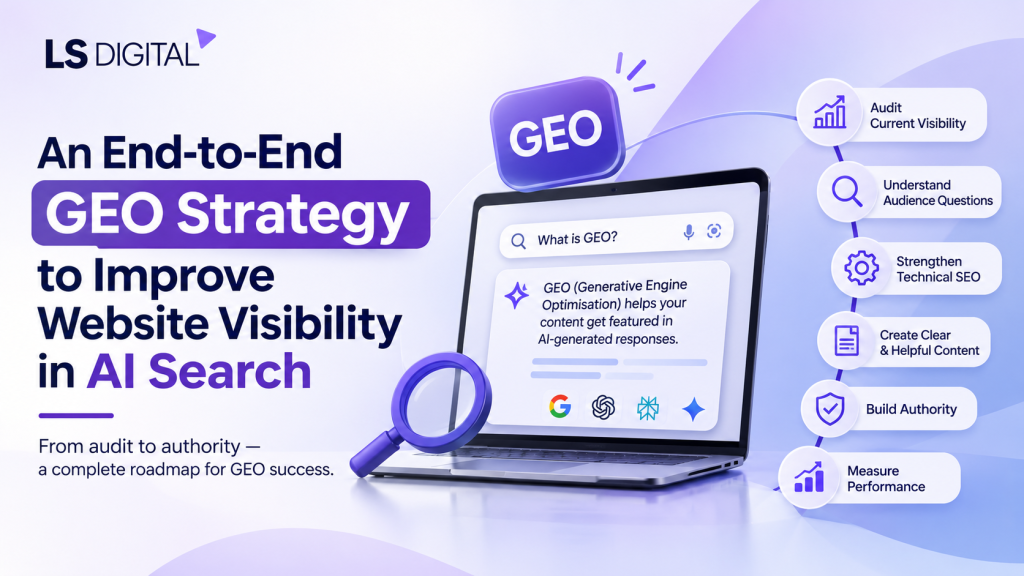
Generative Engine Optimisation (GEO) helps businesses improve their visibility in AI-generated search responses. A strong GEO strategy combines technical SEO, structured content, credible information, brand authority and performance measurement to improve the chances of earning mentions, citations and relevant website traffic.
AI-powered search is changing how people discover information online. Instead of relying only on traditional search results, users increasingly receive summarised answers from platforms such as Google AI Overviews, ChatGPT and Perplexity.
For businesses, this means ranking well is no longer the only visibility goal. Websites also need to be easy for AI systems to discover, understand and reference.
What Is Generative Engine Optimisation?
Generative Engine Optimisation is the process of improving a website so its content has a stronger chance of being surfaced, referenced or cited in AI-generated responses.
SEO remains important because it supports crawling, indexing, relevance and website quality. GEO builds on that foundation by making content clearer, more useful and easier for AI-powered systems to interpret.
A practical GEO approach focuses on three areas:
- Discoverability: Can relevant systems access the content?
- Interpretability: Is the information clear and well structured?
- Credibility: Does the page provide trustworthy, useful information?
How to Build an End-to-End GEO Strategy
An effective GEO strategy should cover the complete journey from understanding current visibility to improving content and measuring results.
Step 1: Audit Current AI Search Visibility
Start by understanding where your brand currently appears across AI-powered search experiences.
Review:
- Brand mentions
- Website citations
- Competitor appearances
- Frequently cited competitor pages
- Important questions where your brand is absent
- Identifiable AI referral traffic
Use a consistent set of prompts across platforms so results can be compared over time.
This gives you a clear baseline before making changes.
Step 2: Identify the Questions Your Audience Is Asking
Traditional keyword research should be supported by question-based research.
Look for searches related to:
- Definitions
- Comparisons
- Recommendations
- Problems and solutions
- Product or service evaluation
- Industry research
- Purchase decisions
For example, instead of creating content only around a broad term such as Generative Engine Optimisation, businesses can also answer questions such as:
- How does GEO improve AI visibility?
- How is GEO different from SEO?
- How can AI citations be measured?
- What makes content more likely to appear in AI search?
This helps content address real user intent rather than simply target keywords.
Step 3: Strengthen Technical Accessibility
Even strong content may struggle to gain visibility if systems cannot access or interpret it properly.
Focus on:
- Crawlability
- Indexability
- Correct canonicalisation
- Clear internal linking
- Logical heading structure
- Relevant structured data
- Mobile usability
- Page performance
- Accessible HTML content
It is also important to review robots.txt settings and understand whether important crawlers can access key pages.
Technical improvements do not guarantee AI citations, but they help remove barriers to discovery.
Step 4: Structure Content for Clear Answers
AI-friendly content should make important information easy to identify.
Each section should answer one clear question or cover one specific topic.
Useful practices include:
- Give the direct answer early.
- Use descriptive H2s and H3s.
- Keep paragraphs short.
- Use bullets where they improve readability.
- Add examples only when they add value.
- Support important factual claims with reliable sources.
- Avoid repeating the same explanation under multiple headings.
The aim is not to create content specifically for AI. It is to make useful content easier for both people and retrieval systems to understand.
Step 5: Build Credibility Around the Topic
AI visibility is not driven only by what appears on one webpage.
Businesses should strengthen the wider signals around their expertise through:
- Original research
- Case studies
- First-hand insights
- Expert authorship
- Clear author information
- Credible external references
- Relevant media coverage
- Consistent brand information
- Regular content updates
This can help establish stronger topical authority and support E-E-A-T principles.
However, no individual credibility signal guarantees inclusion in an AI-generated answer.
Step 6: Build Topic Clusters Instead of Isolated Pages
A single article rarely covers every relevant user need.
Topic clusters allow businesses to build depth around an important subject without forcing everything into one page.
For example:
Pillar Topic: Generative Engine Optimisation
Supporting Topics:
- SEO vs GEO
- GEO measurement
- AI search visibility
- Brand mentions vs citations
- Technical SEO for AI search
- Content optimisation for AI Overviews
A geo expansion strategy can then extend coverage into related questions, formats, industries or audience needs.
The goal is to expand topical relevance without creating overlapping pages that compete with one another.
Step 7: Measure What GEO Is Actually Delivering
GEO measurement should go beyond counting mentions.
Track four areas:
| Measurement Area | What to Track |
| AI Visibility | Brand appearances and recommendations |
| Citations | Number of responses linking to the website |
| Traffic | Visits from identifiable AI platforms |
| Business Impact | Leads, conversions and assisted conversions |
Two useful metrics are:
Brand Appearance Rate = Responses Mentioning the Brand ÷ Total Relevant Responses Tested × 100
Citation Rate = Responses Linking to the Website ÷ Total Relevant Responses Tested × 100
Use the same prompt set, platforms and evaluation method when comparing results over time.
Google Search Console, Google Analytics 4 and AI visibility tools can each provide part of the picture, but no single platform currently captures every AI mention or citation.
Read More: Full Funnel SEO Strategy
SEO and GEO Should Work Together
SEO and GEO should not be treated as competing strategies.
SEO helps establish the technical and content foundation required for search visibility. GEO extends that work towards AI-generated search experiences.
| SEO Focus | GEO Focus |
| Rankings | AI mentions and citations |
| Organic clicks | AI referrals |
| Search intent | Question and answer relevance |
| Crawling and indexing | Retrieval and interpretation |
| Search performance | AI visibility and business impact |
Businesses that focus only on traditional SEO may miss emerging AI discovery opportunities. At the same time, GEO efforts are weaker without strong SEO foundations.
The two should therefore be planned as connected parts of the same search strategy.
What Makes a Strong GEO Content Framework?
A GEO-ready page should make it easy to understand what the page covers, why the information matters and which sections answer specific questions.
A useful framework is:
- Direct answer
- Supporting explanation
- Evidence or example
- Practical business context
- Related next question
This structure helps reduce unnecessary filler and makes individual sections easier to retrieve independently.
It also supports traditional SEO because the page remains focused on user intent.
Common GEO Mistakes to Avoid
Some GEO efforts fail because businesses make cosmetic changes without improving the usefulness of the content.
Common mistakes include:
- Keyword stuffing
- Writing generic summaries with no original value
- Adding unnecessary FAQ sections
- Repeating the same answer under multiple headings
- Ignoring technical SEO
- Publishing unsupported claims
- Measuring mentions without tracking traffic or conversions
- Creating separate pages for nearly identical search intent
The priority should always be useful, clear and credible information.
How Should Businesses Operationalise GEO?
GEO works best when it becomes part of existing marketing workflows.
Different teams can contribute:
- SEO teams can manage technical accessibility and site structure.
- Content teams can develop clear, evidence-led pages.
- Digital PR teams can strengthen external brand authority.
- Analytics teams can monitor visibility, traffic and conversions.
- Marketing leaders can prioritise topics based on commercial relevance.
At LS Digital, GEO can be approached as an extension of broader search and digital marketing strategy rather than a separate content exercise.
This makes it easier to connect visibility improvements with measurable business outcomes.
Conclusion
An effective GEO strategy brings together technical SEO, content structure, topical authority and measurement.
The objective is not simply to appear in more AI-generated answers. It is to improve visibility for relevant searches, earn stronger citations and connect that visibility with meaningful website and business outcomes.
As AI-powered search continues to evolve, businesses that strengthen both SEO and GEO will be better prepared for changes in how people discover and evaluate information online.
Frequently Asked Questions
1. Which Types of Content Are Most Likely to Be Cited in AI Search?
Original research, expert-led content, detailed guides, comparison pages and clearly sourced information can be useful citation sources when they directly answer a user’s query.
2. Does Updating Old Content Help Improve GEO Visibility?
Yes. Refreshing outdated facts, statistics, examples and references can keep important pages accurate and more relevant to current search queries.
3. Should Businesses Block or Allow AI Crawlers?
It depends on the organisation’s content and data policies. Businesses should understand what each crawler does before deciding which AI crawlers to allow or restrict through robots.txt.
4. Can User-Generated Content Support GEO?
It can. Reviews, discussions and community insights may provide useful first-hand perspectives, but they should be moderated and supported by accurate information where necessary.
5. Does GEO Work Differently for B2B and B2C Businesses?
The core principles remain similar, but the queries differ. B2B GEO often focuses on research, comparisons and complex purchase decisions, while B2C searches may be more product-, recommendation- or need-led.