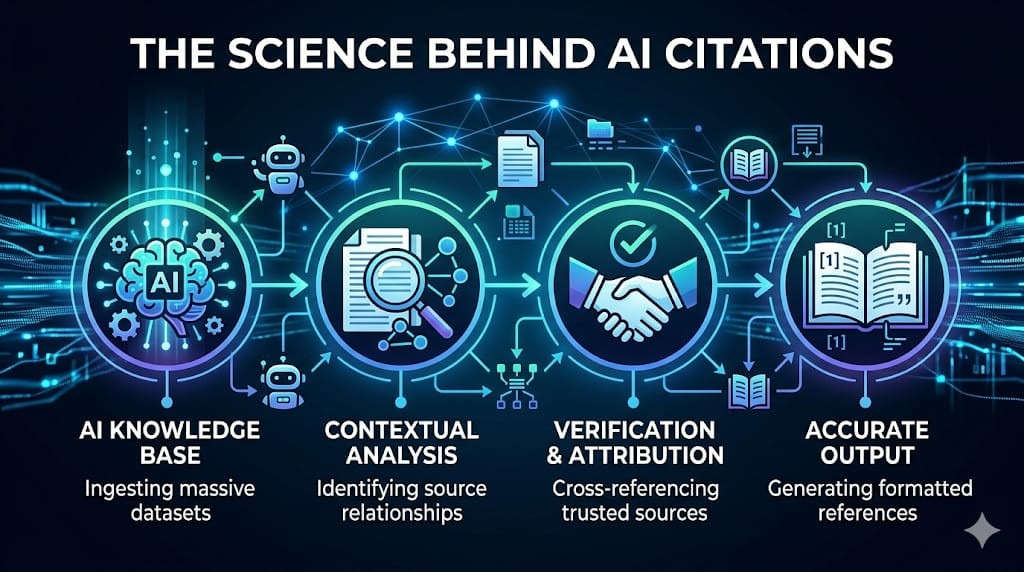
The Science Behind AI Citations: Why Some Brands Get Picked (and Others Don’t)
In the era of AI-driven search, the rules of visibility are being rewritten. Users are increasingly relying on platforms like ChatGPT and Google’s AI-powered search experiences to get direct answers. Within these responses, certain brands are cited, recommended, or referenced—while many others are completely overlooked. This shift raises an important question: why do some brands consistently get picked by AI systems while others struggle to appear?
But here’s the critical question:
Why do some brands get picked by AI, while others remain invisible?
The answer lies in understanding the science behind AI citations—a blend of data training, content structure, authority signals, and contextual relevance.
To understand this, it’s important to first grasp what AI citations actually are. Unlike traditional search results where users choose from a list of links, AI-generated responses synthesize information from multiple sources and present a single, cohesive answer.
In doing so, they may reference specific brands, tools, or websites that are deemed most relevant and trustworthy. These references are what we call AI citations. They are not driven by rankings alone but by a combination of contextual relevance, authority, and clarity.
AI citations occur when generative systems:
- Reference a brand, website, or source in their response
- Summarize or paraphrase content from specific domains
- Recommend tools, companies, or platforms based on learned patterns
Unlike traditional SEO rankings, citations are not just about being #1 on Google. They are about being: “Most useful, most trustworthy, and most contextually relevant”
The Core Science: How AI Models Choose Brands
At the core of this phenomenon lies how AI models are trained and how they retrieve information. These systems learn from vast datasets that include websites, forums, articles, and various forms of structured and unstructured content. When a user asks a question, the AI does not simply “search” like a traditional engine. Instead, it interprets the intent behind the query, identifies relevant knowledge patterns, and generates a response based on probability and trust signals.
When generating answers, they don’t “search” like Google—they:
1.Understand the query context
2.Retrieve relevant knowledge
3.Generate a response based on probability + trust signals
This means that being visible to AI is less about ranking for a keyword and more about being recognized as a reliable and relevant source within a broader ecosystem.
This means brands get cited based on patterns, not just rankings.
5 Key Factors That Influence AI Citations
1. Entity Authority (Not Just Website Authority): A brand that is consistently mentioned across multiple platforms—such as blogs, social media, and communities—develops a stronger identity in the AI’s understanding. This consistency helps the system confidently associate the brand with specific topics or expertise areas, increasing the likelihood of being cited.
2. Content Clarity & Structure: AI models are designed to extract and summarize information efficiently. Content that is well-organized, uses clear headings, provides direct answers, and avoids ambiguity is far more likely to be picked up.
3. Topical Depth & Consistency: AI favors sources that demonstrate sustained expertise on a subject. This means covering a topic comprehensively, building content clusters, and consistently publishing insights over time. Depth signals credibility, and credibility increases the chances of being referenced.
4. Multi-Platform Presence (Beyond Your Website) : AI systems do not rely solely on a brand’s website; they learn from a wide range of sources including social media platforms, video content, forums, and third-party mentions.
5. Trust & Credibility Signals: brands that demonstrate expertise, provide accurate information, and maintain a consistent reputation are more likely to be cited. This aligns closely with the principles of experience, expertise, authority, and trust, (EEAT Signal) which have long been important in SEO but are now even more critical in the AI era.
AI Citations vs Traditional SEO Rankings
| Factor | Traditional SEO | AI Citations |
|---|---|---|
| Focus | Keywords | Context & meaning |
| Goal | Rank on SERP | Be referenced in answers |
| Signals | Backlinks, on-page SEO | Entities, trust, clarity |
| Output | List of links | Direct answer + citations |
Brands that succeed in this new environment tend to share common characteristics. They have clear positioning, create high-quality and structured content, maintain a consistent presence across platforms, and focus on educating their audience rather than simply promoting their products or services.
Ultimately, the rise of AI citations represents a broader shift from ranking to recognition. Users are no longer evaluating multiple options; instead, they are relying on AI to surface the most relevant and trustworthy information. This means that brands must move beyond optimizing for visibility alone and start optimizing for inclusion in AI-driven conversation
Conclusion: The science behind AI citations is not mysterious, it is rooted in patterns of trust, clarity, and consistency. Brands that align with these principles will not only remain visible but will also become integral to how information is discovered and consumed in the future.
In the age of AI search, visibility is no longer about position – it’s about presence
Author Bio:
Ankita Dwivedi
Ankita Dwivedi is an AVP – SEO at LS Digital, specializing in technical SEO, content strategy, and AI-driven search.
She drives scalable organic growth and delivers measurable impact across brands. She is particularly passionate about aligning SEO with user intent, emerging AI search trends, and sustainable digital growth.