Only 19.3% of the 2,981 Indian brands studied achieved “High” AI Visibility across ChatGPT, Gemini and Perplexity. The average brand scored just 30 out of 100, according to DareAISearch’s SearchScore.AI Discovery Index, which assessed brand visibility across AI platforms between April and June 2026.
That points to a significant visibility gap. Many brands are still figuring out how and where they appear in AI-generated answers, while the vocabulary around AI search and GEO is still evolving.
At LS Digital, we work across SEO, ASO, content and digital marketing for brands across categories, and the last year has moved fast. AI has become an increasingly important part of the search experience, changing how people ask questions, discover information and find answers. Along with that shift has come a new set of terms: AI visibility, fanout queries, LLM citations, entities and zero-click result. They are now part of the GEO conversation, but they can still take some getting used to.
This guide breaks down the core GEO terms into four practical groups, helping marketers who are new to the space get oriented while giving experienced SEOs a useful reference to come back to.
Jump to a Section
-
Foundations
-
Visibility & Discovery
-
Content & Authority
-
AI Retrieval & Responses
Tip: in Word, open the Navigation Pane (View, then Navigation Pane) to jump straight to any section or term below.
A. Foundations
These are the basic building blocks: the ideas that make AI-driven search behave differently from keyword-based search.
LLM (Large Language Model)
This is the technology behind tools like ChatGPT, trained to write natural answers instead of just matching keywords. In practice, that means your content is being read and understood now, not scanned for exact phrases.
Prompt
This is what someone actually types into an AI tool, something like “compare term insurance and ULIPs for a 30-year-old.” It’s worth thinking about how a buyer really asks a question, not just the one keyword you happen to be targeting.
Semantic Search
This is about matching meaning rather than exact words. “Affordable term insurance for young professionals” and “best insurance for someone starting their career” are really asking the same thing. Content built around a real question tends to do better than content built around a list of keywords.
Entity
An entity is a specific, recognisable thing: a company, product, person or place that a system can identify. Google’s Knowledge Graph works this way, pulling together a company’s website, its products, and mentions across reviews and news to build a fuller picture of what that brand actually is.
Entity Recognition
This is how AI tells “Amazon” the company apart from the river with the same name. Keeping information about a brand clear and consistent, on its own site and everywhere else it’s mentioned, helps AI systems understand exactly which entity is meant.
B. Visibility & Discovery
This is where marketers start actually watching how, and how well, a brand shows up.
AI Visibility
This is about how often, and how clearly, a brand shows up in AI answers. Not its ranking. It’s actual presence. As that opening stat shows, most brands are scoring low here right now, so the first practical step is simply checking whether a brand shows up at all, and how consistently.
AI Overview
This is the AI-generated summary Google shows at the top of results. Google still handles over 97% of India’s search traffic (StatCounter, 2026), so how it sources these overviews matters quite a bit.
Zero-Click Results
This happens when someone gets their answer from a snippet, a knowledge panel, or an AI summary, without ever clicking through. Being seen and getting a click just aren’t the same thing anymore.
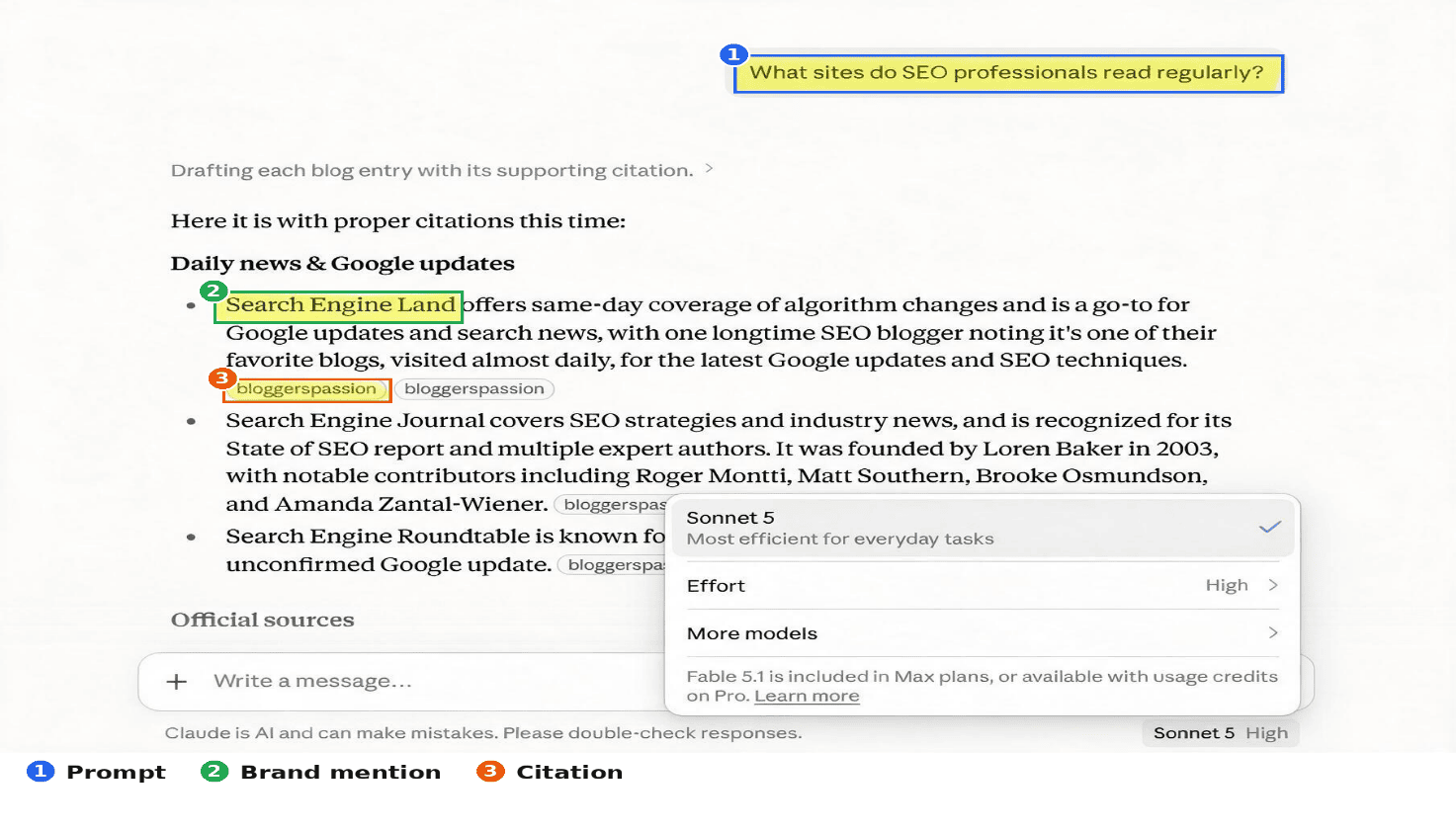
Brand Mention
This is when a brand’s name shows up inside an AI answer, whether or not it’s linked. Ask an AI which mutual funds suit long-term investing in India, and it might say something like: “options such as Alpha Wealth Fund and Bluepeak Mutual Fund are frequently discussed for consistent performance.” That’s a mention. Ahrefs studied 75,000 brands and found these mentions matter roughly three times more than backlinks for AI Overview visibility (Ahrefs, August 2025). It isn’t an India-specific study, but it’s still a useful signal.
Sentiment
This is how an AI talks about a brand once it does show up: positively, neutrally, or with a bit of a caveat attached. An insurer might get described as “reliable but slow with claims,” and that one caveat can shape a buyer’s decision before they’ve even clicked through. Being mentioned isn’t the same as being described well.
C. Content & Authority
This part is less about AI mechanics and more about the content fundamentals that were always good practice and still are.
Topical Authority
This is about how well a brand covers a subject from a lot of different angles, rather than chasing one keyword at a time. A brand with a single post on “term insurance” looks thinner to an AI system than one that’s also covered claim processes, riders and product comparisons.
E-E-A-T
Short for Experience, Expertise, Authoritativeness and Trustworthiness, this is Google’s long-standing way of judging content credibility. AI systems seem to weigh a lot of the same signals when deciding which sources to trust.
LLM Text
This is content written by an AI model. It can speed up production, but volume alone isn’t a GEO strategy. It still needs to be accurate enough to earn trust, and someone still needs to check it before it goes live.
Schema Markup
This is code added to a page that tells search engines, and AI systems, what that page is actually about, things like product prices, FAQs or author details, structured so a machine can read them cleanly. It’s usually a developer’s job to add, but it’s worth knowing it exists, since it can directly affect whether an AI cites a page correctly.
D. AI Retrieval & Responses
This is how AI systems actually pull information together to build an answer.
LLM Citations
Unlike a mention, a citation links back to the actual source, something like “according to Alpha Wealth Fund’s official fact sheet [link].” Citations carry more weight than a mention because they point a reader, and the AI, back to where the claim actually came from.
Fanout Query
This is when an AI quietly breaks one question into several related ones before answering. “Should I invest in mutual funds?” might also pull in questions about risk and time horizon behind the scenes. Content that only answers the main question ends up missing those follow-ups, along with the visibility that comes from answering them.
Hallucinations
This is when an AI confidently states something that’s simply wrong. It’s exactly why accurate, easy-to-find information about a brand matter so much. Any gaps get filled in by the AI’s best guess, right or wrong.
Also read: Reddit GEO
How These Concepts Connect
A brand’s presence tends to move through the same rough path, from being clearly identifiable to actually shaping an AI’s answer:

What Marketers Should Actually Do
- Check how the brand shows up on ChatGPT, AI Overviews and Perplexity for real customer questions, not just brand-name searches.
- Track mentions, citations and sentiment over time rather than as one-off checks, so shifts in how a brand is represented don’t go unnoticed.
- Map the follow-up questions a buyer is likely to ask next, and build supporting content that covers them, not just the main question.
- Keep investing in accurate content and schema markup, the same SEO fundamentals AI systems rely on too.
- Keep tracking rankings and traffic alongside all of this. GEO adds to that picture; it doesn’t replace it.
Search visibility is changing. Brands used to be found through rankings, now they’re increasingly found through answers. SEO still does most of the work, it’s just not the only place a brand needs to show up anymore.
At LS Digital, we bring SEO, GEO, content and digital PR together to shape how your brand is understood and discovered, not just where it ranks. Connect with us to stay visible across search and the generative web.
Because the future of search isn’t just about winning the click.
It’s about becoming part of the answer.
Author Bio:
Nikita Patkar is an SEO Account Manager at LS Digital, specialising in SEO and GEO for BFSI brands. She combines search, content, and AI to build data-led strategies that drive organic visibility and brand discoverability. Off the clock, she’s usually binge-watching or trying new recipes.