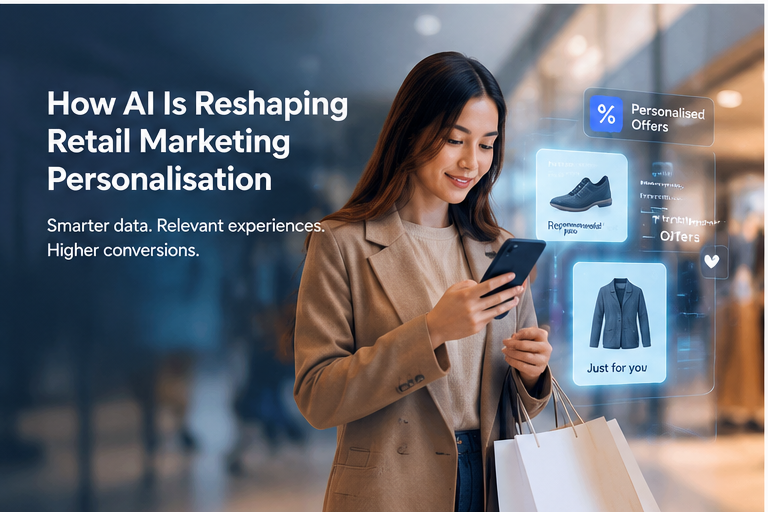
AI-powered personalisation helps retailers deliver relevant product recommendations, targeted promotions and connected shopping experiences. By combining customer data, predictive analytics and intelligent automation, businesses can improve customer engagement, conversion efficiency and long-term customer value.
According to Salesforce’s 2025 Connected Shoppers Report, 39% of surveyed consumers were already using AI for product discovery, with adoption exceeding 50% among Gen Z respondents. This reflects the growing role of intelligent technology in shaping customer purchasing behaviour.
As the adoption of AI in retail industry operations expands, businesses are moving beyond conventional customer segmentation towards more responsive, data-driven engagement. For enterprises, the opportunity lies in connecting customer intelligence with marketing, commerce and technology to deliver relevant experiences while improving commercial performance.
Source:Salesforce – Connected Shoppers Report 2025
What is AI-Powered Retail Marketing Personalisation?
AI-powered retail marketing personalisation uses artificial intelligence, machine learning and customer data to deliver relevant shopping experiences, product recommendations and marketing communications. By analysing customer behaviour, purchase history and preferences, AI-driven personalisation in retail enables businesses to create more targeted interactions across online and offline channels, improving customer engagement and marketing effectiveness.
How is AI Changing Retail Marketing Personalisation?
The adoption of AI in retail marketing is enabling businesses to move beyond broad audience targeting towards more responsive customer engagement. Seven applications are particularly relevant to retailers seeking to improve marketing efficiency and shopping experiences.
1. Personalised Product Recommendations
AI-powered recommendation systems analyse customer preferences, browsing behaviour and transaction history to suggest relevant products. These capabilities help retailers improve product discovery while creating opportunities to increase basket value.
Key applications include:
- Product Relevance: Recommend products based on customer interests, purchase history and browsing behaviour.
- Cross-Selling Opportunities: Suggest complementary products that align with items customers have selected or purchased.
- Personalised Discovery: Introduce relevant products from categories customers haven’t previously explored.
- Real-Time Recommendations: Adjust suggestions based on changing customer interactions and product availability.
2.AI-Powered Search and Product Discovery
AI-powered search helps retailers interpret customer intent rather than relying exclusively on exact keyword matches. This enables more relevant product discovery, particularly when customers describe requirements through conversational queries or images.
Important capabilities include:
- Semantic Search: Interpret the meaning and context behind customer queries to deliver relevant results.
- Visual Search: Enable customers to discover similar products using images.
- Intelligent Product Ranking: Prioritise products based on customer preferences, relevance and availability.
- Conversational Search: Allow shoppers to refine product choices through natural-language interactions.
3.Personalised Offers and Promotions
AI enables retailers to develop targeted promotional strategies by analysing purchasing behaviour, customer engagement and historical campaign performance. This helps improve promotional relevance while reducing unnecessary discounting.
Retailers can use AI for:
- Targeted Promotions: Align offers with customer interests, product preferences and purchasing behaviour.
- Promotion Timing: Identify suitable opportunities to communicate offers based on engagement patterns.
- Predictive Segmentation: Group customers according to purchase likelihood, loyalty and engagement levels.
- Incentive Optimisation: Evaluate promotional effectiveness to improve incremental sales and marketing efficiency.
4.Dynamic Website and App Experiences
AI allows retailers to adapt digital experiences according to customer preferences, browsing intent and previous interactions. Personalised interfaces can simplify navigation, improve content relevance and support conversion across websites and mobile applications.
Key applications include:
- Personalised Homepages: Display relevant categories, products and promotional content.
- Adaptive Product Listings: Organise product recommendations according to individual browsing behaviour and interests.
- Contextual Content: Present suitable buying guides, product comparisons and relevant information.
- Journey Optimisation: Identify friction points and improve navigation, usability and conversion pathways.
5.Personalised Email and Marketing Campaigns
AI strengthens marketing automation by using customer behaviour and predictive insights to deliver more relevant communication. Retailers can adapt campaign content, timing and frequency according to customer preferences and engagement patterns.
Important applications include:
- Predictive Customer Segmentation: Identify audiences based on purchasing behaviour, engagement and lifecycle stage.
- Personalised Campaign Content: Tailor product suggestions and messaging to customer interests.
- Send-Time Optimisation: Estimate suitable communication times based on historical engagement.
- Automated Customer Journeys: Trigger relevant messages following purchases, cart abandonment or periods of inactivity.
6.Predictive Customer Insights
Predictive analytics is among the most valuable applications of AI in retail, helping businesses identify patterns in customer behaviour and anticipate potential outcomes. These insights support more informed marketing investment, merchandising and retention decisions.
Key applications include:
- Purchase Propensity Analysis: Estimate the likelihood of customers purchasing particular products or categories.
- Customer Lifetime Value Prediction: Forecast potential long-term customer value to inform marketing investment.
- Churn Prediction: Identify customers showing signs of declining engagement.
- Demand Forecasting: Anticipate purchasing trends to support inventory planning and promotional decisions.
7.Conversational AI and AI Shopping Assistants
Conversational AI is expanding the role of AI in customer experience by enabling customers to receive interactive shopping assistance. Connected to accurate product and service information, AI assistants can support product evaluation, purchasing decisions and customer service.
Retailers can use these systems for:
- Guided Product Selection: Recommend suitable products based on customer requirements and preferences.
- Product Comparisons: Explain differences in specifications, features and product suitability.
- Purchase Assistance: Provide relevant information about availability, delivery and return policies.
- Customer Support: Address routine enquiries and escalate complex issues to human representatives.
How AI Personalisation Works Across the Retail Customer Journey
Personalisation in retail delivers greater value when customer intelligence informs interactions throughout the entire shopping journey. Connecting these experiences helps businesses maintain relevance from initial discovery through purchase and retention.
| Customer Journey Stage | AI Application | Personalised Experience |
| Awareness | Predictive audience analysis | Relevant advertising and content based on customer interests |
| Search experience | Users navigate search results to access websites | Users receive generated responses that may reference multiple sources |
| Discovery | AI-powered search and recommendations | Products aligned with shopping intent and preferences |
| Consideration | Conversational AI and product comparisons | Guidance on product features and suitability |
| Conversion | Contextual offers and experience optimisation | Relevant incentives and simplified purchase journeys |
| Post-Purchase | Automated lifecycle communication | Order updates, product guidance and replenishment reminders |
| Retention | Churn prediction and loyalty analytics | Timely engagement based on customer behaviour |
For enterprise retailers, integrating customer data across commerce, CRM and marketing platforms enables more coordinated interactions, subject to appropriate privacy and consent controls.
Benefits of AI-Powered Personalisation for Retailers
AI-powered personalisation helps retailers improve customer engagement, marketing efficiency and sales performance by delivering more relevant shopping experiences. Evaluate its effectiveness through measurable business outcomes rather than the volume of personalised interactions.
Key benefits include:
- Improved Conversion Rates: AI helps customers discover relevant products and simplifies product selection, increasing the likelihood of purchase.
- Higher Average Order Value: Personalised recommendations and cross-selling opportunities encourage customers to explore complementary products, potentially increasing basket value.
- Greater Customer Retention: AI identifies changes in customer behaviour and enables timely, relevant communication to encourage repeat purchases and long-term engagement.
- Improved Marketing Efficiency: Predictive insights and targeted promotions help retailers allocate marketing budgets more effectively and reduce unnecessary promotional spending.
- Better Customer Experience: Personalised product suggestions, relevant content and tailored interactions make shopping experiences more convenient and aligned with customer preferences.
- Data-Driven Decision-Making: AI converts customer and transaction data into actionable insights that support marketing strategies, product planning and merchandising decisions.
According to McKinsey, personalisation at scale can improve retail sales when implemented effectively. However, results depend on the retail category, customer behaviour, technology maturity and quality of execution.
Source: McKinsey – Personalising the Customer Experience
Challenges of Using AI for Retail Personalisation
Implementing AI personalisation requires retailers to address challenges related to customer data, technology integration and responsible AI adoption. These considerations are particularly important for enterprises managing multiple sales channels and complex digital infrastructures.
Key challenges include:
- Fragmented Customer Data:
Disconnected customer information across platforms can lead to inconsistent profiles and experiences. Retailers should integrate relevant data sources to develop a more unified view of customer behaviour. - Privacy and Consent: Improper data handling can create regulatory risks and weaken customer trust. Businesses should establish appropriate privacy controls, consent management processes and data protection practices.
- Inaccurate Recommendations: Poor data quality or unreliable algorithms can result in irrelevant product suggestions. Regular model monitoring and accurate product information are essential for maintaining recommendation quality.
- Technology Integration: Compatibility issues between commerce, CRM and analytics platforms can delay implementation. Retailers should assess their existing technology infrastructure before deploying AI personalisation solutions.
- Algorithmic Bias: AI models may produce unfair or inconsistent outcomes for different customer groups. Regular evaluations can help identify bias and support more equitable personalisation.
- Measuring ROI: Demonstrating the financial impact of personalisation can be challenging. Retailers should establish clear KPIs and use controlled experiments to measure incremental revenue, conversion improvements and customer retention.
How Can Retailers Prepare for AI-Driven Personalisation?
Effective implementation requires retailers to align customer intelligence, technology capabilities and commercial objectives. A structured approach helps organisations prioritise suitable applications and establish the foundations for scalable retail personalisation strategies.
Businesses should focus on:
- Assess Customer Data Readiness: Evaluate the quality, accessibility and accuracy of customer, product and transaction data across relevant systems.
- Prioritise High-Value Applications: Identify personalisation opportunities linked to conversion efficiency, customer retention and marketing performance.
- Integrate Marketing and Commerce Platforms: Connect relevant CRM, e-commerce, analytics and automation systems to support coordinated customer interactions.
- Establish Performance Measurement: Track conversion uplift, average order value, repeat purchase rates and incremental revenue through appropriate testing methods.
- Implement Responsible AI Governance: Establish privacy controls, model monitoring, human oversight and clear accountability for AI-driven decisions.
Conclusion
The future of retail marketing will increasingly depend on how effectively businesses translate customer intelligence into relevant, commercially valuable experiences.
Understanding how AI is changing retail involves recognising its role across product discovery, marketing activation, commerce and customer engagement rather than viewing personalisation as an isolated technology application.
For enterprises, long-term value will depend on connected data systems, responsible implementation and measurable performance. Retailers that integrate AI personalisation into their wider digital business strategies will be better positioned to improve marketing efficiency, strengthen customer relationships and respond to changing consumer expectations.
Frequently Asked Questions (FAQs)
1.How is AI improving the retail customer experience?
AI supports more relevant product discovery, personalised recommendations, intelligent search and conversational shopping assistance. These applications can help customers find suitable products and complete purchases more efficiently.
2.What are the main applications of AI in retail marketing?
Major applications include recommendation engines, predictive analytics, intelligent product search, personalised promotions, automated campaigns, dynamic website experiences and conversational AI.
3.How can AI personalisation improve retail sales?
AI can help retailers improve product relevance, cross-selling and customer engagement. Businesses should measure incremental conversion rates, average order value and revenue to evaluate its commercial impact.
4.What are the biggest challenges of AI-driven personalisation?
Common challenges include fragmented customer data, privacy requirements, technology integration, algorithmic bias, inaccurate recommendations and difficulties measuring return on investment.
5.Can retailers use AI personalisation across online and offline channels?
Yes. Retailers can connect appropriate customer data from e-commerce platforms, mobile applications, loyalty programmes and physical stores to support coordinated experiences, subject to relevant privacy and consent requirements.
6.How should retailers measure AI personalisation performance?
Retailers should evaluate conversion uplift, average order value, customer retention, campaign efficiency and incremental revenue. Controlled testing can help determine whether personalisation delivers measurable improvements.