For the last few years, we have been preparing brands for a major shift in search.
People are no longer just typing keywords into Google. They are asking ChatGPT, Gemini and other AI platforms questions like:
“Which is the best SUV for a family of five?”
“Suggest a skincare routine for oily skin.”
“Which CRM is best for a growing business?”
And naturally, the SEO industry has evolved with it. We are now talking about AI visibility, citations, brand mentions and Generative Engine Optimisation.
But search is now moving beyond AI-generated answers. AI agents are increasingly capable of connecting with external systems, using tools and acting on information.
Technologies such as Model Context Protocol (MCP) are already enabling this shift.
The Difference: AI That Finds vs AI That Does
Let’s take a simple example.
Imagine you ask an AI today:
“Find me a beachfront hotel in Goa under ₹10,000 for my anniversary.”
The AI can already do a lot. It can search the web, compare hotels, read reviews and recommend a few options.
But after that, you still need to do the work.
- You open multiple websites.
- Check whether rooms are available for your dates.
- Compare prices.
- Select a room.
- Fill in your details.
- And finally, make the booking.
Now imagine a slightly different experience.
You tell your AI assistant:
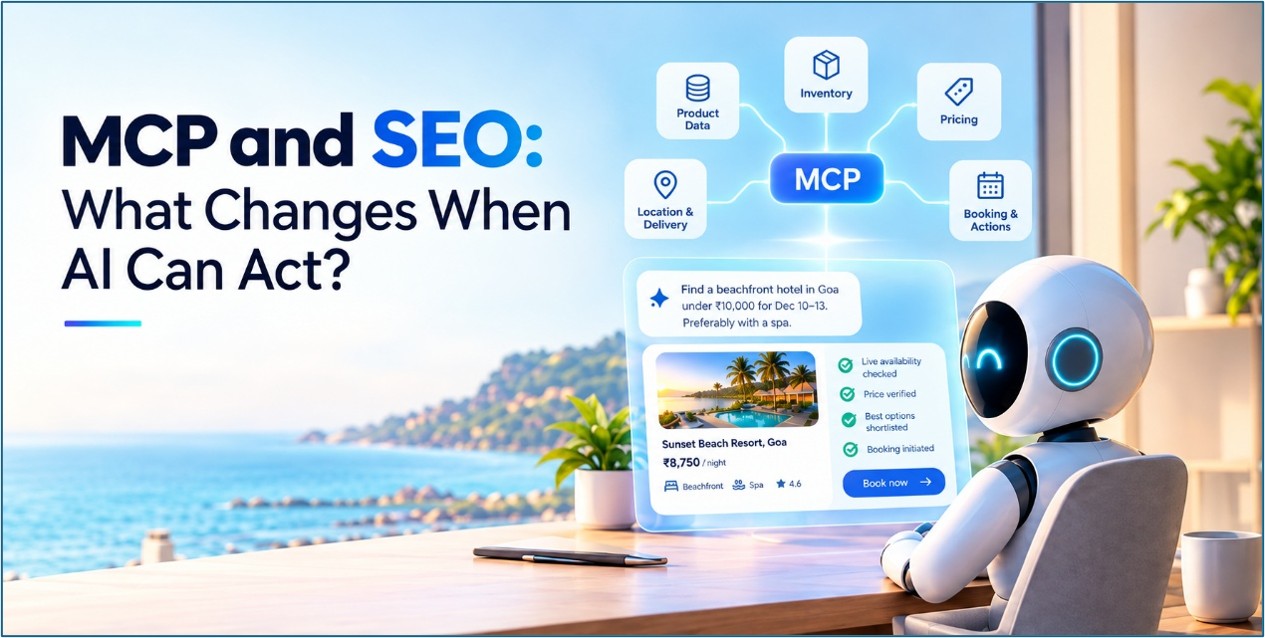
“Find me a beachfront hotel in Goa under ₹10,000 for December 10–13. Good reviews, preferably with a spa.”
Instead of just giving you links, the AI agent could potentially connect with authorised hotel or travel systems, check live availability, compare actual prices and present options that are genuinely available.
With the right permissions and connected tools, it could even help move the task towards completion.
That is the important difference.
Today’s AI primarily helps us find and understand information.
Agentic AI can potentially help us use information and interact with systems to get something done.
So, Where Does MCP Come In?
Think of MCP as a common connector.
Today, if an AI needs to interact with ten different systems – say inventory software, a booking platform, a CRM or a product database, each connection can require its own integration.
MCP aims to create a more standardised way for AI applications to connect with external tools and data sources.
A simple analogy would be a universal adapter.
You don’t need to understand the technical details to understand its potential impact:
It can help AI move beyond reading information on the internet and, with authorised access, interact with the systems where real-time information and actions exist.
And that is where the SEO conversation gets interesting.
What Could This Look Like Across Industries?
E-commerce
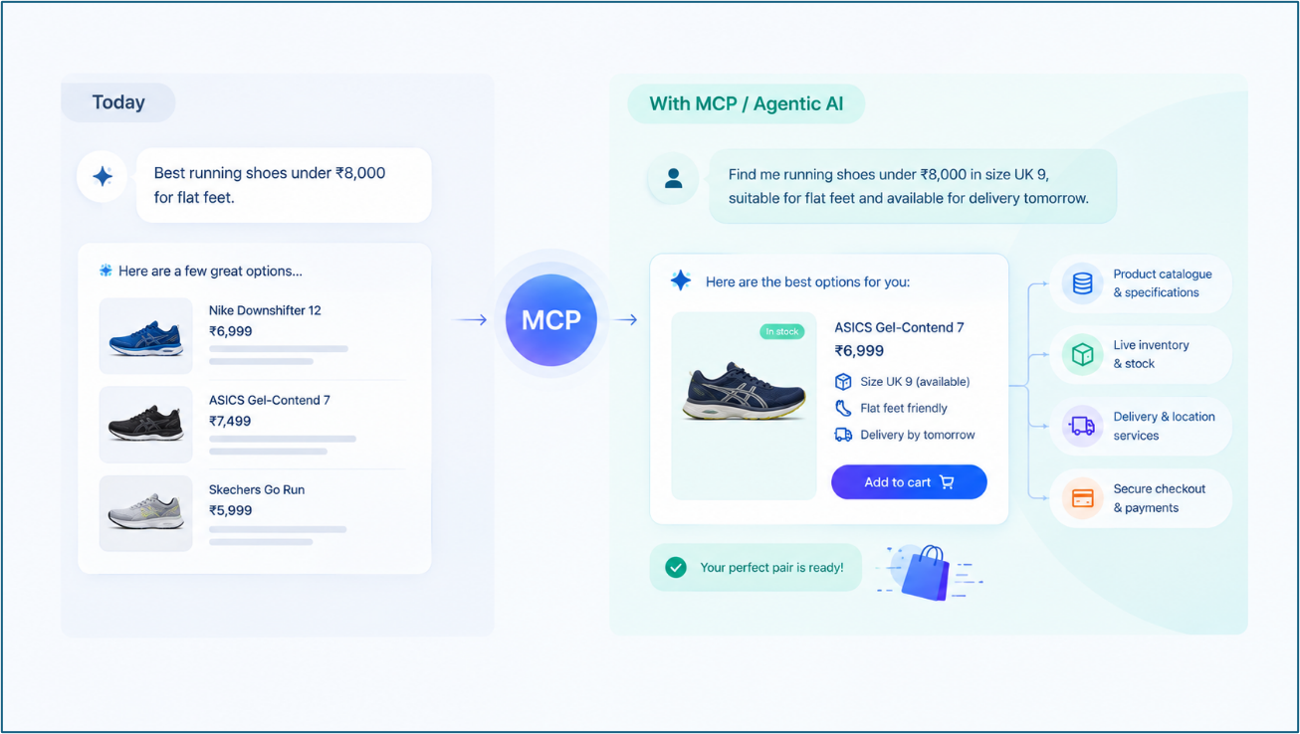
Today, an AI can recommend a pair of running shoes based on reviews and product information available online.
But imagine asking:
“Find me running shoes under ₹8,000 in size UK 9, suitable for flat feet and available for delivery tomorrow.”
This requires more than reading a product page.
The AI needs access to current product information, size availability, inventory and delivery capabilities.
Automotive
Today, AI can compare different cars based on specifications available online.
But a future interaction could look like:
“I have a budget of ₹50 lakh. Configure an electric SUV suitable for my family, check availability near me and book a test drive for Saturday.”
Now the journey involves more than content.
It could involve a vehicle configurator, dealer inventory, location data and a test-drive booking system.
B2B
Today, an AI can compare different CRM platforms based on websites, reviews and articles.
But a business could eventually ask:
“Find a CRM suitable for a 200-member sales team, compare pricing based on our requirements and schedule demos with the top three options.”
The AI agent would need to move beyond simply reading websites. It would need access to relevant product information and tools that help progress the decision.
What Does This Mean for SEO?
This is where we need to be careful. MCP is not another ranking factor.
Adding MCP to a website will not suddenly make it rank higher on Google or get it mentioned by ChatGPT.
The larger implication is about how we think about a brand’s digital presence in an agentic search ecosystem.
For years, SEO has focused heavily on webpages and rankings.
Then Generative AI pushed us to think beyond rankings: Can AI understand our brand? Can it retrieve our content? Will it cite or recommend us?
The agentic world introduces another question:
If an AI agent needs to help a user complete a task involving our business, can it access the right information and capabilities?
The future may not be about replacing SEO. It may be about expanding what SEO teams consider part of the search and discovery ecosystem.
The evolution could look something like this:
Search Era: Can users find my website?
Generative AI Era: Can AI understand and recommend my brand?
Agentic Era: Can an AI agent use my information and capabilities to help a user get something done?
How Can Brands Start Preparing?
Brands need to start understanding how their digital ecosystems may need to evolve for agentic AI.
1. Get your information ecosystem in order
Ensure important business information is accurate, structured and consistent.
Products, services, specifications, locations, pricing and policies shouldn’t be scattered or contradictory across different systems.
2. Think beyond webpages
Some of the most valuable information about a business doesn’t live neatly on a webpage.
It may exist in product databases, inventory systems, CRMs or internal tools.
Businesses should start identifying which information and capabilities could eventually be useful in an AI-driven journey.
3. Identify actions, not just content
Ask a simple question:
What does a customer usually do after finding information about us?
Do they check availability? Calculate a price? Find a dealer? Book a demo?
These actions could become increasingly important touchpoints in an agent-driven ecosystem.
The Bigger Shift
Generative AI has already changed how people search.
The next phase changes what happens after the search.
Instead of AI simply helping users discover information, AI agents can increasingly become intermediaries that help users research, evaluate and act.
For SEO professionals and businesses, this means thinking beyond one question:
“How do I get more visibility?”
And starting to ask:
“Is my business digitally prepared for an AI to understand, evaluate and interact with it?”
At LS Digital, we see Agentic AI as a fundamental shift in how search works – not simply a new way to discover information, but a move towards AI systems that can understand intent, connect data, use tools and complete tasks. This means SEO needs to expand beyond webpages and rankings to make brands discoverable, understandable and actionable within AI-driven journeys.
Author Bio

Dhanashri Kachare is an SEO manager at LS Digital, helping brands turn search opportunities into sustainable organic growth. She works across SEO & GEO strategy, content, and AI-powered search experiences to improve discoverability, attract relevant audiences, and build long-term search performance.