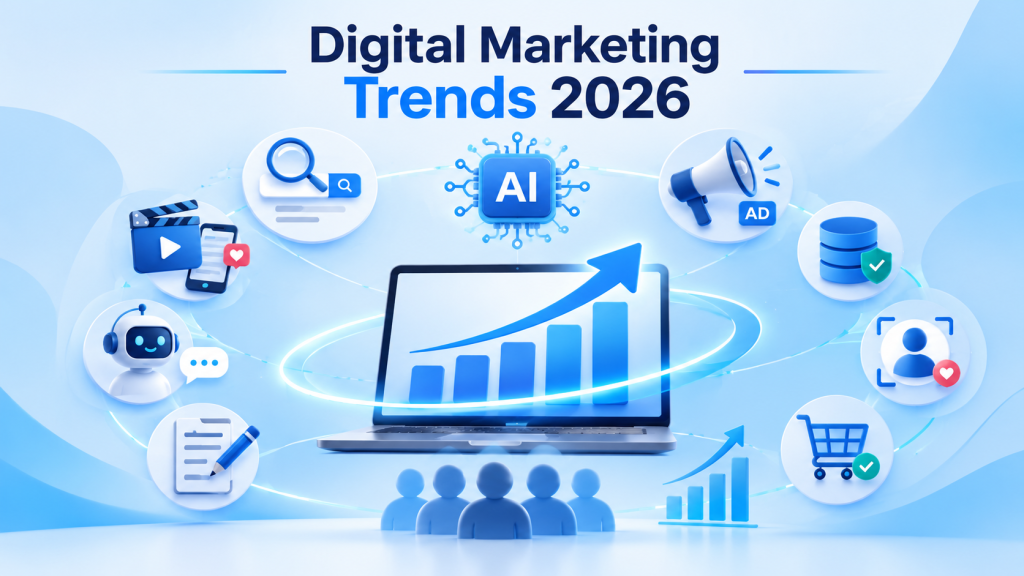
Digital marketing in 2026 is becoming more AI-driven, personalised and focused on measurable business outcomes. Brands need to adapt to changing search behaviour, stronger automation, first-party data, creator-led content and more connected customer journeys. The priority is not adopting every new tool, but using the right technologies and channels to improve visibility, engagement and business performance.
Digital marketing trends in 2026 reflect a major shift in how people discover brands, compare options and make decisions. Search engines, AI platforms, social media and digital advertising now influence different parts of the customer journey.
For brands, this means marketing strategies need to be more connected. Content, media, data, technology and measurement must work together instead of operating as separate functions.
What Are the Top Digital Marketing Trends in 2026?
The most important digital marketing trends 2026 are shaped by artificial intelligence, changing search behaviour, privacy, personalisation and stronger expectations around marketing performance.
1. AI Search Is Changing Brand Discovery
Search is no longer limited to traditional search engine results pages. Consumers increasingly use AI-powered tools to research products, compare services and find recommendations.
Platforms such as Google AI Overviews, ChatGPT and Perplexity are influencing how information is discovered.
Brands should therefore focus on:
- Strong Search Engine Optimisation (SEO)
- Answer Engine Optimisation (AEO)
- Generative Engine Optimisation (GEO)
- Clear, credible and well-structured content
- Consistent brand information across digital platforms
SEO, AEO and GEO complement each other. A brand that performs well across all three has a stronger chance of appearing throughout both traditional and AI-led search journeys.
2. AI-Powered Advertising Is Expanding Automation
Advertising platforms are using AI more extensively for bidding, targeting, creative delivery and campaign optimisation.
This reduces the amount of manual campaign management required, but it also increases the importance of strong inputs.
Brands should pay closer attention to:
- Conversion quality
- Audience signals
- Creative variation
- Accurate tracking
- Campaign objectives
- Business-level performance
The role of marketers is shifting from manually controlling every setting to guiding automation with better data, stronger strategy and clearer outcomes.
3. First-Party Data Is Becoming More Important
Privacy changes have made first-party data increasingly valuable.
This includes information collected directly through websites, CRM systems, purchases, subscriptions and consent-based customer interactions.
Brands can use first-party data to:
- Build stronger audience segments
- Improve personalisation
- Support customer retention
- Strengthen campaign optimisation
- Reduce dependence on third-party data
The focus should remain on collecting useful information transparently and using it responsibly.
4. Personalisation Is Becoming More Behaviour-Based
Personalisation is moving beyond basic recommendations or personalised greetings.
Brands can increasingly tailor experiences based on browsing behaviour, purchase history, interests, engagement patterns and customer lifecycle stage.
This can influence:
- Website experiences
- Product recommendations
- Email journeys
- Retargeting
- Offers and messaging
The strongest personalisation strategies are useful rather than intrusive. They make interactions more relevant without making customers feel overly tracked.
5. Short-Form Video and Creator Content Remain Important
Short-form video continues to play a major role in digital discovery.
Instagram Reels, YouTube Shorts and creator-led content can help brands demonstrate products, explain benefits and reach audiences in formats that are easy to consume.
Instead of focusing only on reach, brands should evaluate:
- Engagement quality
- Watch time
- Website visits
- Leads
- Assisted conversions
- Sales impact
Creator partnerships should also be based on audience relevance and credibility rather than follower count alone.
6. Social Commerce Is Reducing the Gap Between Discovery and Purchase
Social platforms increasingly influence both product discovery and purchase decisions.
A customer may discover a brand through a creator or social post, research the product, visit the website and complete a purchase within a short period.
Brands should make this journey easier through:
- Clear product information
- Strong calls to action
- Social proof
- Customer reviews
- Easy movement from content to commerce
This makes social media more closely connected with performance marketing and e-commerce.
7. Omnichannel Marketing Is Becoming More Connected
Customers interact with brands across multiple channels before converting.
A typical journey may include social media, search, a website visit, email communication and a paid ad.
Brands need to connect these touchpoints rather than evaluate each one independently.
This requires:
- Consistent messaging
- Connected customer data
- Cross-channel measurement
- Clear customer journey mapping
- Better coordination between media, content and CRM teams
A connected approach gives brands a more complete view of how marketing influences decisions.
8. Marketing Measurement Is Moving Beyond Platform ROAS
ROAS remains useful, but it does not always show the complete contribution of marketing.
Google Ads, Meta, analytics platforms and internal systems may report different numbers because they use different attribution models and conversion windows.
Brands are increasingly looking at broader metrics such as:
- Blended ROAS
- Customer Acquisition Cost
- Customer Lifetime Value
- Incrementality
- Contribution margin
- Qualified leads
- Revenue
This helps businesses evaluate whether marketing is creating real commercial value rather than simply generating platform-reported conversions.
9. Conversational Marketing Is Becoming More Useful
AI-powered chatbots and messaging tools are improving how brands respond to customer questions.
They can support:
- Product discovery
- Lead qualification
- Frequently asked questions
- Customer service
- Appointment or enquiry flows
Automation is most useful when it handles routine interactions while allowing customers to reach a person when their query becomes more complex.
10. Original Content and Brand Authority Matter More
AI has made content creation faster, but this also means generic content is easier to produce.
Brands therefore need stronger differentiation.
Useful content in 2026 should offer:
- Original insights
- Expert perspectives
- First-party research
- Practical examples
- Clear answers
- Updated information
This is one of the current digital marketing trends that affects both search visibility and brand credibility. Content needs to add value rather than simply repeat information already available elsewhere.
Read More: What Services Should a Full-Service Digital Marketing Agency Offer in 2026?
How Should Brands Respond to Digital Marketing Trends in 2026?
Brands do not need to adopt every new technology at the same time.
A better approach is to identify which digital marketing industry trends are most relevant to their audience, marketing maturity and business goals.
A practical process is to:
- Review current channel and campaign performance.
- Identify where customer behaviour is changing.
- Prioritise gaps in search visibility, data, customer experience or measurement.
- Test new approaches on a controlled scale.
- Measure results against business outcomes before expanding.
This helps brands respond to change without spreading budgets and resources across too many initiatives.
What Do Digital Marketing Trends 2026 Mean for Brands?
The digital marketing trends shaping 2026 point towards a more connected marketing environment.
AI is changing search and advertising, first-party data is strengthening personalisation, and measurement is becoming more closely tied to actual business outcomes.
For brands, the focus should be on building an integrated strategy where content improves discoverability, technology supports efficiency, data improves relevance and measurement guides decision-making.
At LS Digital, this approach brings together media, creative, data and technology to help brands respond to changing digital behaviour and build stronger marketing outcomes.
FAQs
1. What Is the Biggest Digital Marketing Challenge for Brands in 2026?
One of the biggest challenges is keeping customer experiences consistent while using more channels, platforms, data sources and AI-powered tools.
2. How Can Brands Decide Which New Marketing Technology to Adopt?
Brands should evaluate whether the technology solves a clear business problem, integrates with existing systems and can deliver measurable value before investing in it.
3. Will Zero-Click Searches Affect Website Traffic in 2026?
Yes. More users may get answers directly from search and AI interfaces, so brands need to measure visibility, mentions and assisted discovery alongside website clicks.
4. Why Is Marketing Technology Integration Important in 2026?
Connected marketing systems help brands bring together customer data, campaign activity, content and measurement, reducing fragmented experiences and reporting gaps.
5. How Can Brands Prepare Their Marketing Teams for Future Digital Changes?
Brands can focus on continuous learning, stronger collaboration between media, content, data and technology teams, and regular testing of new tools and customer behaviours.