
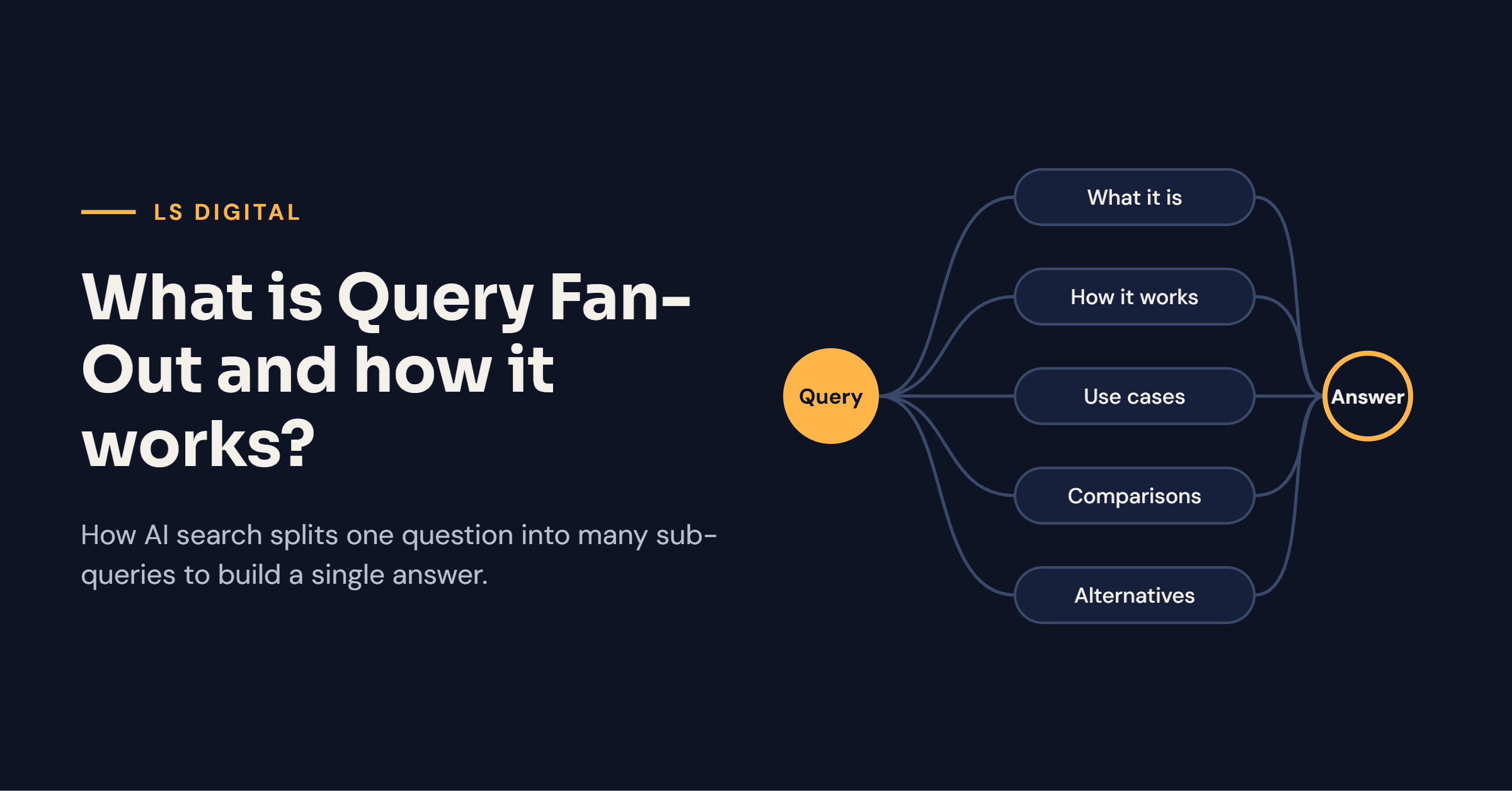
Query fan-out is the process modern search engines and large language models (LLMs) use to break a single user prompt into several distinct subqueries before answering.
The logic behind this is simple: a nuanced question is rarely answered fully by a single document. So when an AI engine processes a prompt, it fans out into parallel searches — exploring definitions, comparisons, use cases, costs, and caveats simultaneously — and then weaves the strongest findings into one unified response. Google’s Search Central documentation notes that both AI Overviews and AI Mode may use a query fan-out technique, and other AI search tools use comparable approaches, although the exact details are not public.
✦ Intent Decomposition: the engine splits one broad question into several narrow, targeted sub-questions.
✦ Multidimensional Retrieval: it searches simultaneously for facts, comparisons, and expert perspectives across sources.
✦ Contextual Synthesis: it weaves the strongest, most relevant fragments into one coherent, unified answer.
✦ Relevance Scoring: each fragment is ranked against its subquery before it earns a place in the final answer.
How one query branches into subqueries: a simple example
Take a shopper who types “best running shoes for flat feet.” Instead of running that one search, an AI engine may break it into related questions: what support flat feet need, how stability shoes compare with neutral ones, which models are worth considering, and how to size and replace them. The diagram below shows those subqueries and how each one can become a planned content block.
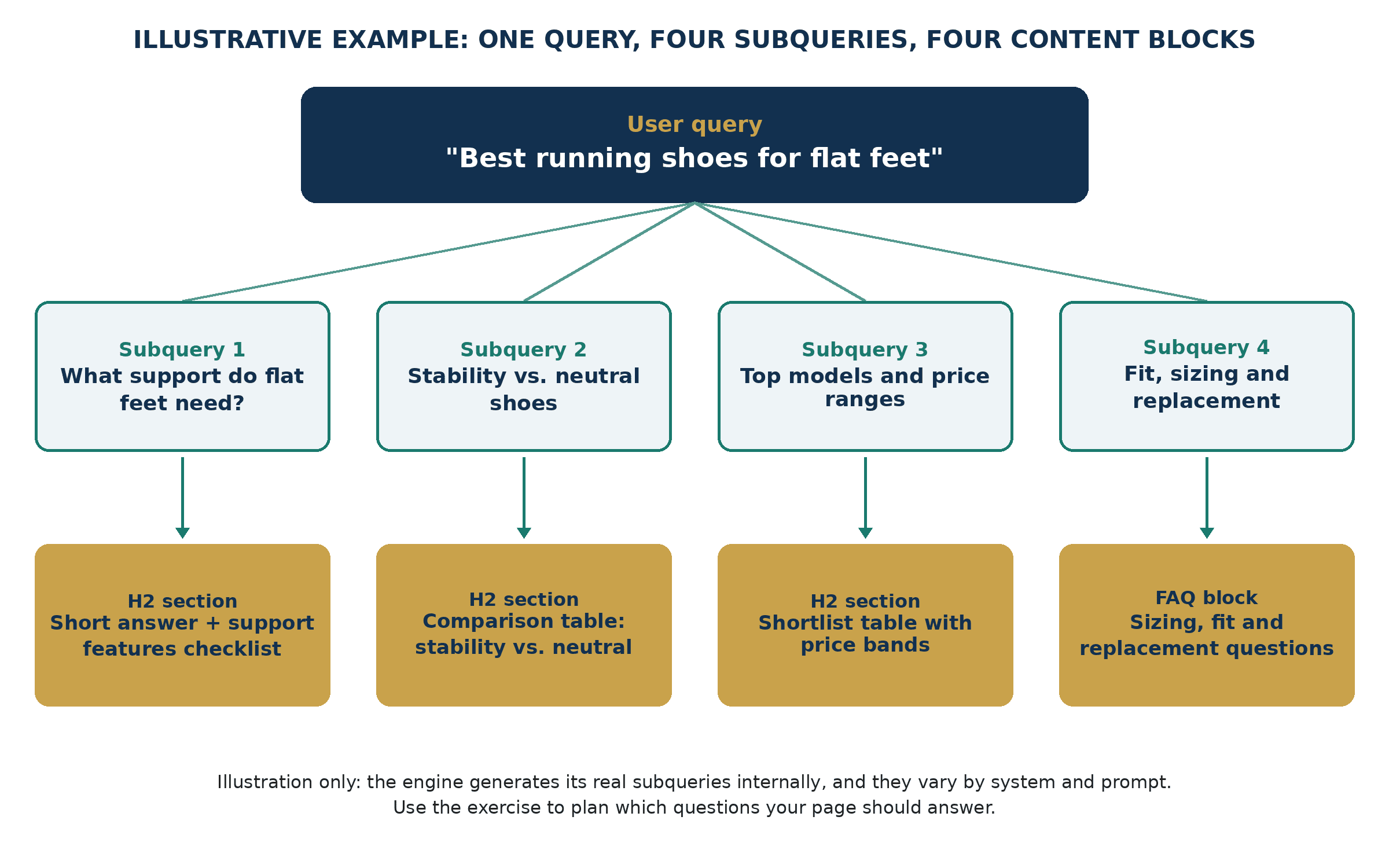
This is why fan-out is useful for content planning: each subquery maps to a section, table or FAQ that the page can answer on its own. A page that covers only “best running shoes” misses most of these branches, while a page planned around all four gives the engine more relevant passages to choose from.
2) How to Optimize Content for LLMs Using Query Fan-Out
To get captured when an AI engine fans a prompt out, your content has to move past traditional keyword targeting and into holistic topic architecture. A page needs to satisfy not just the primary question, but every adjacent sub-question an intelligent system is likely to generate around it.
- ✔ Map anticipated sub-intentions: study your core topic and list 4–6 logical follow-up questions users naturally ask — grouped around definitions, specifications, cost, and common pitfalls.
- ✔ Adopt modular content structuring: organize articles into self-contained subsections with clear, descriptive H2/H3 headings and direct summary blocks, so retrieval models can extract exact passages for exact subqueries.
- ✔ Incorporate semantic depth and context: go beyond thin, surface-level definitions — add real context, edge cases, and industry standards so one page can satisfy several subquery intents at once.
- ✔ Leverage structured formatting: use bulleted lists, comparison tables, and FAQ blocks throughout. Clearly structured text is generally easier for AI systems to parse, which makes it simpler to pull a precise answer for each fanned-out query.
- ✔ Reinforce with structured data: layer relevant schema markup (such as Article, Product or Organization) on top of your content so machines can match narrow, attribute-level subqueries to clean, labelled data points.
Using query fan-out to find content gaps and plan SEO and GEO content
Marketers can use fan-out as a practical planning lens. A simple workflow:
1. List the likely subqueries. Write out the follow-up questions around your target topic, using People Also Ask, related searches and the answers AI tools give for the same prompt. Engines do not publish their actual fan-out queries, so treat your list as an informed estimate.
2. Audit your page against the list. Mark each subquery as covered, partly covered or missing, and check that each answer is easy to find under its own heading.
3. Turn the gaps into a plan. Add or strengthen a section, table or FAQ for each gap, and refresh anything out of date. This supports SEO through broader topic coverage and GEO through more passages worth citing.
4. Measure and repeat. Track rankings, AI citations and engagement over time, and revisit the list as people’s questions change.
For the running-shoes example above, a quick audit might look like this:
| Likely subquery | Coverage today | Planned action |
| What support do flat feet need? | Partly covered (one line in the intro) | Add a dedicated H2 with a short answer and a feature checklist |
| Stability vs. neutral shoes | Missing | Add a comparison table |
| Top models and price ranges | Covered, but outdated | Refresh the shortlist and add price bands |
| Fit, sizing and replacement | Missing | Add an FAQ block |
One caution: add depth where it genuinely helps readers. Google warns that creating separate content for every possible variation of a search, including fan-out queries, primarily to manipulate rankings or AI responses violates its scaled content abuse spam policy.
3) Impact and Reasons to Use This Approach
Adopting a query fan-out mindset shifts your content strategy from guessing at a single keyword to covering the full range of questions people ask around a topic. That can improve your chances of being surfaced in AI search, though no tactic guarantees citations or rankings.
✦ Better pages that cover several related subqueries give AI systems more relevant passages to draw from. In a small Semrush test of four articles over one month, citations in tracked prompts rose from two to five, and a Surfer SEO analysis found that pages ranking for fan-out queries were more likely to be cited in Google AI Overviews. Both are limited samples and correlations, so treat them as signals rather than guarantees.
✦ Potentially Google says its ranking systems favor helpful, reliable, people-first content, and thorough topic coverage fits that goal. No approach can promise protection from algorithm updates, so keep monitoring your performance.
✦ Possible a page that answers related questions in one place may reduce the need for readers to go back to search. This is an expectation rather than a proven result: bounce rate also depends on page speed, layout and how well the page matches the visitor’s intent, so measure engagement in your own analytics instead of assuming a drop.
✦ Compounding consistently answering the full spread of subqueries can help demonstrate real expertise over time, rather than relying on keyword targeting alone.
4) Example of Query Fan-Out in Action
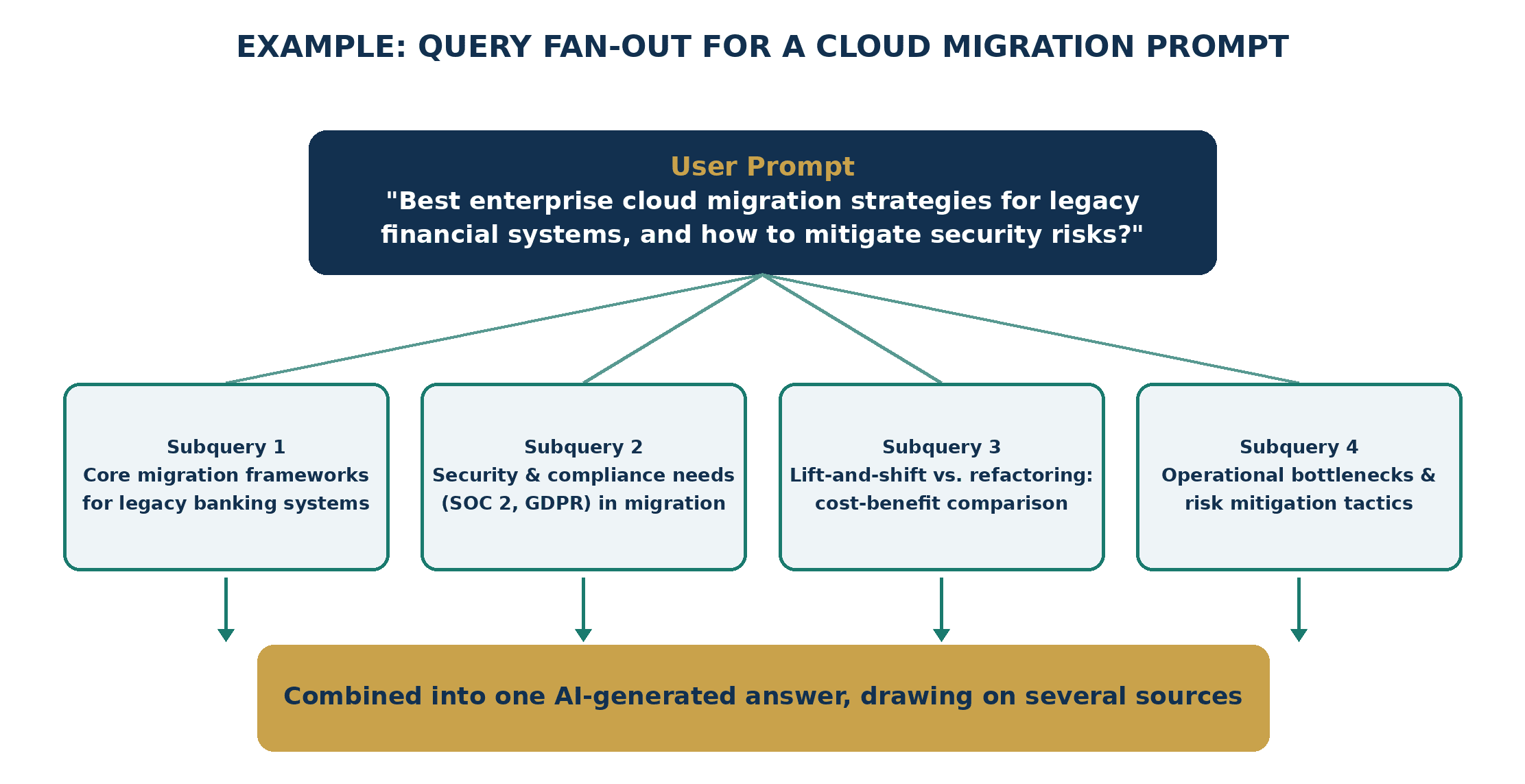
To see query fan-out in action, consider how a complex, high-stakes user prompt might be processed, and how an optimized article can address each thread of it. This is a hypothetical example for illustration, not a case study, and the subqueries are our own estimate because engines do not publish theirs.
User Prompt:
“Best enterprise cloud migration strategies for legacy financial systems, and how do we mitigate security risks?”
How an AI Engine Might Fan Out the Query:
➜ Subquery 1: core cloud migration frameworks for legacy banking architectures
➜ Subquery 2: security and compliance requirements (SOC 2, GDPR) during financial data migration
➜ Subquery 3: cost-benefit comparison of lift-and-shift vs. refactoring approaches
➜ Subquery 4: common operational bottlenecks and risk-mitigation tactics
The Fan-Out Optimization Solution:
An optimized article won’t stop at a generic definition of cloud migration. It uses modular H2 sections that directly address migration methodologies, a dedicated cost-vs-risk comparison table, a compliance checklist, and clear security mitigation protocols. Because each section answers a distinct subquery on its own, a retrieval system can more easily find and extract a relevant passage. That improves the page’s chances of being cited as a source, though it does not guarantee it.
Conclusion
Query fan-out is changing how content gets discovered and evaluated in AI search. By structuring your pages around multidimensional subquery intent, rather than a single rigid keyword, you improve your chances of visibility across AI search engines, answer engines, and LLM citations alike, although no approach can guarantee results.
Author Bio:
Madhuja Chavan is a Senior Specialist – SEO at LS Digital with around 4 years of experience in SEO strategy, content optimization, technical SEO, and organic growth. Madhuja has worked across consumer durables, home appliances, and financial services brands, helping them improve their online visibility through data-driven SEO and high-quality content. Specializing in GEO and AEO, she helps brands show up in AI-generated answers as well as traditional search results.
LinkedIn: Madhuja Chavan | LinkedIn