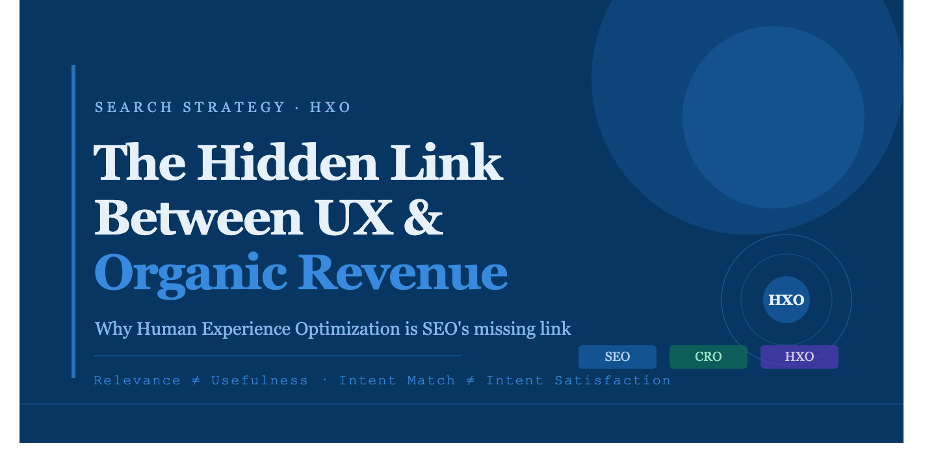
Why Human Experience Optimization (HXO) Is SEO’s Missing Link
As search evolves, ranking for relevance is no longer enough. The next competitive advantage may belong to brands that help users complete tasks with less effort and greater confidence
Most SEO professionals have experienced some version of this story.
Rankings improve. Organic traffic climbs. Non-brand visibility expands. Monthly reports show encouraging growth, and stakeholders are pleased with the direction of travel.
Then someone asks a question that instantly changes the conversation: “If organic visibility is growing, why isn’t revenue growing at the same pace?”
For years, the industry has had a fairly standard answer. We looked at conversion rates. We examined landing pages. We questioned CTAs, forms, and checkout journeys. The assumption was that if SEO had done its job and users were arriving, the remaining challenge belonged elsewhere.
But what if the problem isn’t always conversion?
What if, increasingly, it’s experience?
That question feels particularly relevant today. Much of the industry’s attention is focused on AI-powered search experiences, AI Overviews, GEO, AEO, and whatever acronym emerges next. Yet beneath all these conversations lies a more significant shift.
Search engines are becoming increasingly capable of understanding content. Google’s AI Overviews, AI Mode, and Helpful Content system signal a broader shift toward evaluating content through the lens of usefulness, context, and user satisfaction rather than keyword alignment alone. The real question is what happens when understanding content is no longer the competitive advantage.
Because if search engines are getting better at identifying relevance, then the differentiator may no longer be who creates the most content or who targets the most keywords. It may be who creates the most useful experience.
Search Is Evolving from Relevance to Usefulness
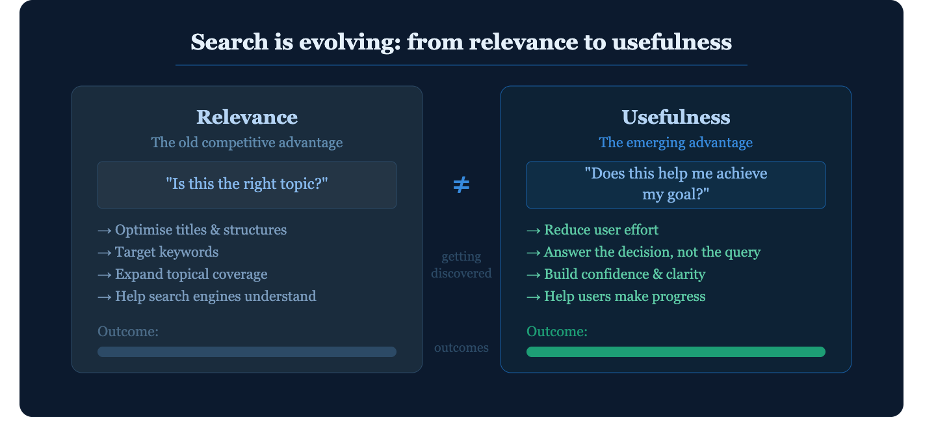
For much of SEO’s history, the challenge was helping search engines understand pages. We optimised titles, refined content structures, built internal linking systems, expanded topical coverage, and created content designed to signal relevance. Success depended on helping search engines correctly interpret what a page was about. Those fundamentals still matter.
However, recent developments in search, including the direction signalled through Google’s latest updates and AI-powered experiences, suggest that search is moving beyond simple relevance matching. Search engines are becoming increasingly effective at understanding context, relationships, intent, and meaning.
The gap between what a page says and what a search engine understands has narrowed dramatically. What hasn’t narrowed is the gap between content that ranks and content that genuinely helps.
Consider how users behave on an e-commerce category page. Very few arrive intending to read every word. They are looking for signals that help them make progress: product availability, price ranges, relevant filters, reviews, comparisons, sizing guidance, and reassurance that they are in the right place.
If those signals are difficult to find, the ranking has technically succeeded. The page has not.
Relevance gets a page discovered. Usefulness helps a user make progress.
Google’s recent search evolution reflects this distinction. Increasingly, the winners are not simply the pages that mention the right topics, but the pages that help users complete tasks, make decisions, and find answers with less effort.
This shift is giving rise to a broader discipline known as Human Experience Optimization (HXO): the practice of reducing friction and helping users achieve outcomes with greater clarity, confidence, and less effort. As search engines become increasingly effective at understanding relevance, competitive advantage is shifting toward the quality of the experience users encounter after the click.
And increasingly, that distinction matters. Relevance answers the question: “Is this the right topic?”
Usefulness answers a much harder one: “Does this help me achieve what I came here to do?”
The more search evolves, the more important that second question becomes.
The Industry’s Blind Spot
This shift forces us to revisit some long-standing SEO practices.
For years, many websites added content primarily to strengthen discoverability. Category descriptions grew longer. Footer content expanded. Internal link blocks multiplied. The objective was understandable: help search engines better understand the page and improve its ability to rank. These tactics are not inherently wrong. In fact, some of them remain valuable. The more interesting question is whether we are evaluating them through the right lens.
Historically, we asked: “Does this help the page rank?”
Increasingly, we may need to ask: “Does this help the user complete their task?”
Take category-page content as an example. If a category description helps users understand product differences, navigate choices, or make more confident decisions, it earns its place. If it exists solely to reassure search engines that the page is sufficiently detailed, its value becomes harder to justify.
This isn’t an argument against content.
It’s an argument for usefulness.
The websites that succeed in the next phase of search may not be the ones creating the most content. They may be the ones reducing the most effort. And this is where another important distinction begins to emerge.
Intent Match Is Not Intent Satisfaction
SEO professionals have spent years refining their understanding of search intent.
We categorise keywords. We map content to journeys. We identify whether users want information, products, services, or answers. Intent matching has become one of the foundations of modern SEO. But matching intent and satisfying intent are not the same thing.
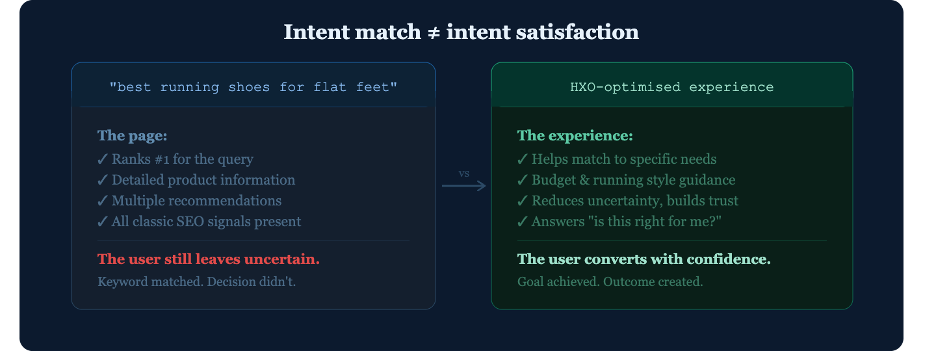
Intent Match ≠ Intent Satisfaction.
Imagine someone searching for “best running shoes for flat feet.”
A page may rank perfectly for that query. It may contain detailed information, product recommendations, and all the elements typically associated with strong SEO.
Yet the user still leaves uncertain. Why?
Because the page answered the query without solving the decision. The user wasn’t looking for information alone. They were looking for confidence. They wanted help understanding which option fit their specific needs, budget, running style, and experience level.
The keyword matched.
The outcome didn’t.
This pattern appears constantly across e-commerce and digital experiences. Product pages explain features but fail to answer whether a product is right for a specific user. Service pages explain offerings but fail to reduce uncertainty. Content addresses topics without helping people move forward. And that’s where the gap between visibility and value begins to appear.
Content addresses topics without helping people move forward. And that’s where the gap between visibility and value begins to appear.
Which raises a bigger question: If SEO earns the click, what determines whether that click creates value?
The Missing Layer Between SEO and Revenue
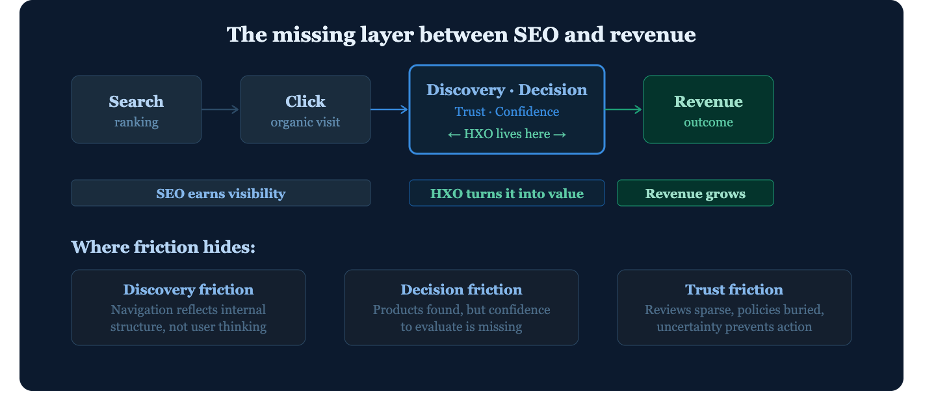
Traditionally, SEO has focused on visibility and CRO has focused on conversion. Yet there is a significant space between those two moments that often goes unnamed. It is the space between discovery and decision. Between arriving and acting. Between traffic and revenue.
This is where Human Experience Optimization (HXO) enters the conversation. Not as another industry buzzword. Not as a replacement for SEO. But as a framework for understanding what happens after visibility has been earned. At its core, HXO is concerned with helping users achieve outcomes with greater clarity, confidence, and less effort. Because when users fail to convert after arriving organically, the issue is often not visibility. It’s friction.
A research from an Institute estimates that the average large e-commerce site can increase conversion rates by 35.26% through checkout and user experience improvements alone, highlighting how experience often becomes the limiting factor once visibility has been achieved.
Sometimes users struggle to discover what they need after landing on a page. Navigation reflects internal business structures rather than customer thinking. Filtering experiences fail to support exploration. The user arrives with intent but encounters unnecessary effort.
Sometimes the friction is tied to decision-making. Users find relevant products but cannot confidently evaluate them. Questions remain unanswered. Comparisons are difficult. Important information is buried.
And sometimes the issue is trust. Reviews are limited. Delivery information is unclear. Policies require effort to find. Nothing feels obviously wrong, yet uncertainty quietly prevents action.
None of these issues typically appear in ranking reports. All of them influence revenue. This is why SEO performance and business performance don’t always move together.
SEO generates opportunity. HXO determines how much of that opportunity becomes value.
How Brands Can Improve Organic Revenue Through HXO?
The answer isn’t abandoning traditional SEO. The answer is expanding how we define success.
As search becomes increasingly capable of understanding content, brands need to become increasingly capable of understanding users. That starts by asking different questions from this curated HXO checklist.
- Can users compare products?
- Can users make a decision?
- Is trust established?
- Is pricing obvious?
- Are objections answered?
- Is navigation effortless?
- Does every section reduce effort?
The organisations that adapt most effectively to the next phase of search will likely be those that stop viewing SEO as a traffic acquisition channel alone and start viewing it as a user experience discipline.
Because visibility without usefulness creates attention.
Usefulness creates outcomes.
From Discoverability to Usefulness
The significance of recent search developments is not simply that AI is changing search. It is that search is becoming better at understanding content. And when understanding becomes easier, the competitive advantage shifts elsewhere.
Not toward more keywords.
Not toward more pages.
Not toward more optimisation tactics.
Toward usefulness.
Search engines are becoming better at understanding content. Users are becoming less patient with it. The brands that succeed in the years ahead won’t simply be those that earn visibility. They’ll be the ones that make progress easiest.
Key Takeaways
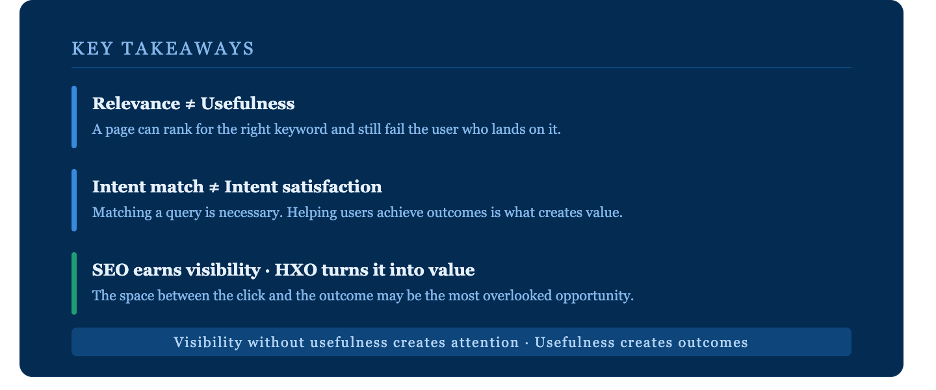
Relevance ≠ Usefulness
A page can rank for the right keyword and still fail the user who lands on it.
Intent Match ≠ Intent Satisfaction
Matching a query is necessary. Helping users achieve outcomes is what creates value.
SEO earns visibility. HXO turns visibility into value.
The space between the click and the outcome may be the most important optimisation opportunity many brands are still overlooking. The brands that remove that friction will own the next decade of organic growth.
At LS Digital, we combine SEO, GEO, HXO, CRO, Content Intelligence and Analytics to help brands move beyond rankings and build organic experiences that drive measurable business outcomes.
Author Bio:

Pranali Darekar is a Senior Specialist – SEO at LS Digital, with expertise in SEO strategy, content optimization, technical SEO, and organic growth. She has worked across e-commerce, SaaS, fintech, and lifestyle brands, helping businesses improve their online visibility through data-driven SEO strategies and high-quality content. Passionate about creating user-first content & driving AI-visibility.