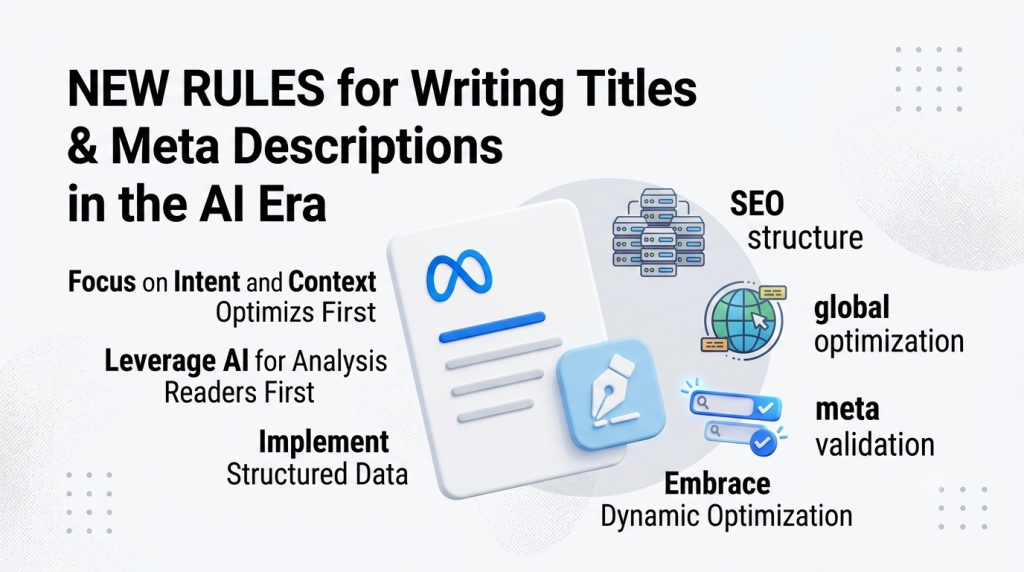
Rethinking SERP Strategy in the Age of Generative Search
Your title tag isn’t fighting for a click anymore. It’s auditioning for a mention inside an AI’s answer.
That’s the shift nobody quite prepared us for. For twenty years, a title and meta description had one job: earn a click on a results page full of blue links. Today, they have a second, bigger job. They’re often the first thing an AI system reads to decide whether your page deserves to be quoted, summarized, or cited at all.
The Illusion of Control
Here’s an uncomfortable truth: most of what you write in your title tag won’t survive contact with Google.
Google rewrites titles most of the time and rewrites meta descriptions even more often. Think about what that actually means. You could spend an hour agonizing over the perfect 58-character title, and there’s a real chance Google swaps in its own version before a searcher ever sees yours.
For years, SEO teams treated this as a losing battle. It isn’t. It’s a signal. Google doesn’t rewrite metadata to be difficult, it rewrites it when your title and description don’t clearly match the substance of the page. The algorithm is essentially saying, “I don’t fully trust that this headline represents what’s actually here, so I’ll write one myself.”
That flips the whole exercise on its head. The goal was never to write a title Google keeps. The goal is to write a title so accurate, so aligned with your page, that Google has no reason to touch it. One clear pattern backs this up: titles that closely mirror a page’s main heading get rewritten far less often than titles that don’t. Alignment, not cleverness, is what earns you control.
Half the Search Results Page Is Now AI-Written
AI Overviews, Google’s AI-generated answer boxes, now appear on roughly half of all US searches. Pause on that for a second. Half. That means for an enormous chunk of queries, the first thing a user sees isn’t a list of links you’re competing to rank in, it’s a paragraph an AI wrote by reading, digesting, and synthesizing several sources at once, including possibly yours.
This is the part every marketer needs to internalize: ranking #1 no longer guarantees visibility. Getting cited inside that AI-written answer is the new prize, because the sources cited in AI Overviews often see a meaningful lift in clicks from the people who scroll past the summary wanting more. And here’s the twist that should worry anyone coasting on old rankings: the overlap between what AI chooses to cite and what actually ranks in the top ten has been shrinking. AI is pulling its answers from a much wider pool than the usual top-ranking suspects.
In plain terms: your competition for visibility just expanded. You’re not only up against the ten blue links anymore. You’re up against every reasonably well-structured, well-explained page on the topic that an AI model happened to read.
The 3C Framework: How to Write Metadata AI Will Actually Trust
If you remember nothing else from this article, remember this framework. It’s a simple lens for writing metadata that works in 2026, whether a human or an AI reads it first.
Clarity. Does your title and description say, in plain language, exactly what a reader gets? No clever wordplay, no vague teasers. AI systems, and busy humans, reward content that states its purpose immediately.
Credibility. Does your metadata reflect real expertise, not just claim it? This is where E-E-A-T (Experience, Expertise, Authoritativeness, Trustworthiness) comes in. AI models increasingly use these signals as a trust filter before deciding whose content is worth surfacing. A near-unanimous share of marketers surveyed in 2026 already expect E-E-A-T to matter even more going forward, and that’s not a fad, it’s the industry recognizing that AI needs a way to separate real expertise from confident-sounding noise.
Citability. Is your content structured clearly enough that an AI could lift a clean, accurate answer from it? This is where structured data earns its keep. Pages using structured data properly are significantly more likely to get picked up and cited by AI systems. Think of structured data as translation, you’re not just writing for people anymore, you’re labeling your content so a machine can understand it without guessing.
Map these three against how metadata has evolved, and you get a useful timeline:
- The SEO Era — metadata written for rankings. Keyword-stuffed, algorithm-first.
- The SERP Era — metadata written for clicks. Copywriting-first, built to win attention on a crowded results page.
- The AI Era — metadata written for Clarity, Credibility, and Citability. Built to earn trust from a system that reads, judges, and sometimes speaks on your behalf.
Every era before this one was about being chosen by a person. This one is also about being understood by a machine that then chooses on a person’s behalf.
Writing Titles and Descriptions People (and AI) Actually Want
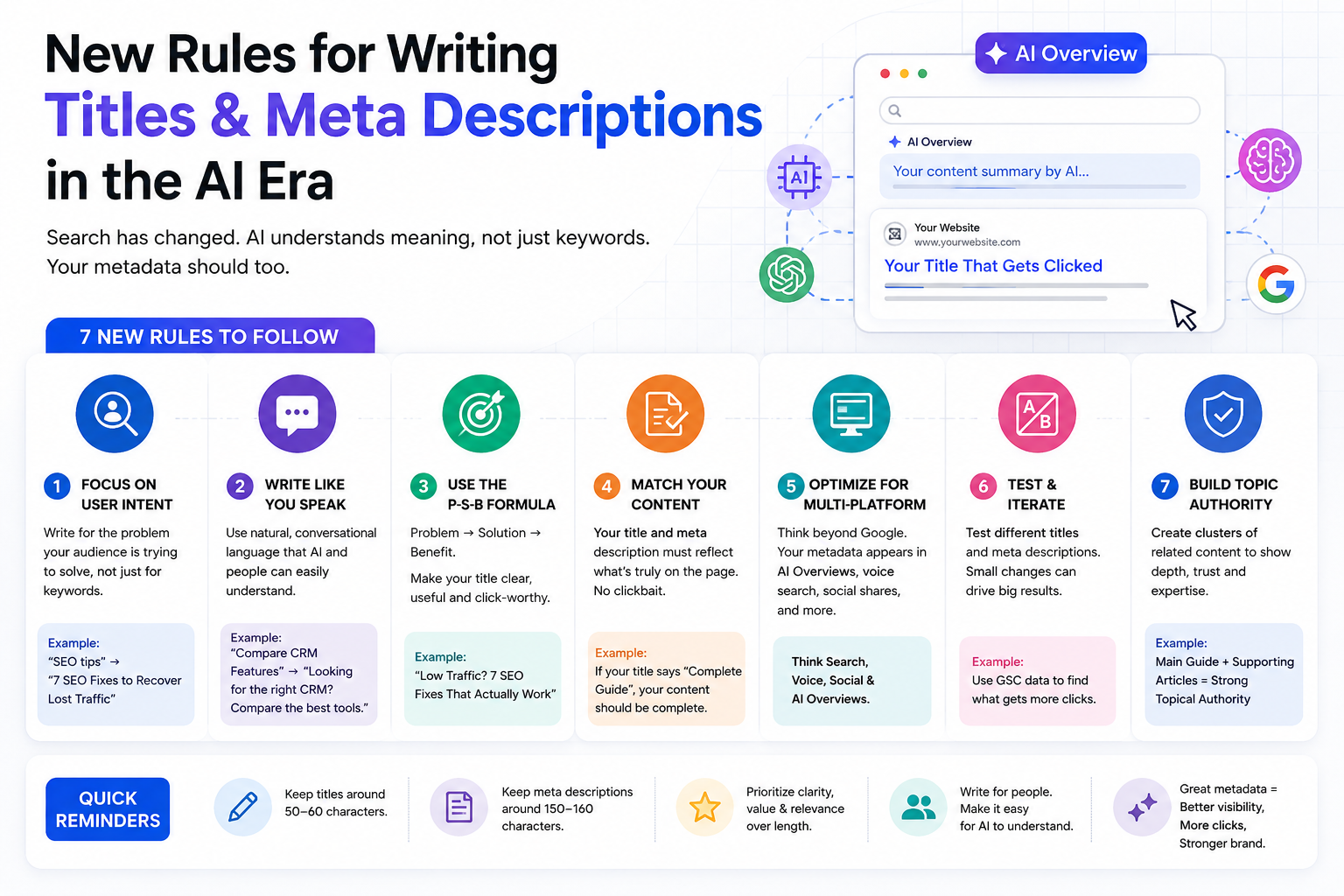
Forget cramming in keywords. AI cares about what you’re actually trying to say far more than whether you hit an exact phrase.
Get specific about who your page is for and what they’ll walk away with. Instead of something generic, try naming the audience and the outcome directly, something like “Best CRM Software for Scaling Sales Teams.” That level of specificity does more work than any keyword ever could.
Meta descriptions deserve the same honesty. Skip the dry “learn more about X” language, nobody has ever clicked because of that sentence. Speak to the actual problem someone’s dealing with. “Struggling to scale your sales pipeline? Here’s what actually works for high-growth teams” will always beat a dry list of features, because it sounds like it was written by someone who understands the reader’s day.
And remember, your title and description aren’t just showing up on Google anymore. They’re shaping how your content looks in AI Overviews, voice assistants, LinkedIn previews, and browser tabs. Write for all of those places at once, not just one.
This Isn’t Just an SEO Problem Anymore
Here’s where most articles on this topic stop short. They treat metadata as an SEO team’s homework. It isn’t, not anymore.
If you’re a CMO, metadata is now a brand visibility question, not a technical checkbox. Every time your content gets rewritten or skipped by an AI system, that’s a missed opportunity to shape how your brand gets described to a customer who never even visits your site.
If you’re a Marketing Head, this is a budget conversation. The channels people use to find your brand are quietly shifting from “search and click” to “ask and get told.” That changes what good content investment looks like, and it changes how you measure success.
If you’re on a Brand team, your voice is now partially in the hands of an algorithm that summarizes you. Clear, consistent, well-labeled content is the closest thing you have to a say in how AI represents your brand in someone else’s conversation.
If you’re on a Content team, the pressure to write once and rank forever is gone. You’re now writing for topical depth, structural clarity, and machine readability, alongside the human reader you’ve always written for.
The common thread across all four roles is the same: AI visibility, brand authority, qualified traffic, and customer trust are no longer separate conversations. They all run through the same door, and that door is your metadata and the content standing behind it.
Build Depth, Not Just Pages
AI systems reward real depth on a topic over a single article trying to cover everything. That’s what content clusters are for: a pillar page covering the big picture, cluster pages diving into specific subtopics, and supporting pages answering narrow questions. Link them together properly, and you’re telling AI systems, in a language they understand, that you actually know this subject.
That structural signal matters as much as any single sentence of metadata. A well-linked cluster tells an AI model where the expertise lives on your site. A single orphaned page, no matter how well-written its title tag is, tells it nothing.
Quick Questions, Quick Answers
Do titles and meta descriptions still affect rankings?
Titles, yes, they’re still a real ranking factor. Meta descriptions don’t directly move rankings, but they heavily influence whether people click.
How often does Google actually rewrite this stuff?
Often enough that you shouldn’t take it personally. But titles that closely match your H1 get left alone far more consistently, so alignment is your best lever for control.
How do I get my content cited by AI?
Write genuinely thorough content that directly answers the question being asked. Use structured data, keep your content current, and build the E-E-A-T signals that give a machine a reason to trust you.
Should I still worry about character limits?
Treat them as a guideline, not a law. Going slightly longer is fine if it makes your message clearer for both readers and AI. Just don’t sacrifice clarity to hit an arbitrary number.
Why does E-E-A-T matter so much now?
Because an AI system can’t build a relationship with your brand the way a returning customer can. E-E-A-T signals are its shortcut for deciding who’s worth trusting on your behalf.
The Bottom Line
Titles and meta descriptions aren’t dying. They’re being promoted.
They used to be your pitch to a person scanning a results page. Now they’re also your pitch to a machine deciding whether you’re worth quoting to that person at all. Write for rankings, and you’ll fall behind. Write for clicks alone, and you’ll miss half the opportunity. Write for clarity, credibility, and citability, and you’re building something that survives whatever the results page looks like next year.
The teams that treat metadata as a trust signal, not just a traffic tactic, are the ones AI will keep choosing to speak for.
Author Bio:

Jennifer Dsouza is an Associate Director specializing in SEO at LS Digital Marketing agency. She develops data-driven strategies that enhance search visibility, drive high-intent traffic, and deliver measurable business impact. Her expertise spans content strategy, technical SEO, and leveraging emerging trends to build scalable, performance-focused organic growth frameworks.