What if your #1 ranking stopped mattering tomorrow?
For years, securing the top spot on search engine results pages felt like winning the internet. It meant visibility, traffic, and often, conversions. But today, that equation is quietly breaking.
AI-led experiences, like Google’s AI Overviews and conversational platforms such as ChatGPT, Perplexity, and Claude are changing how people interact with information.
Instead of scanning links and choosing where to click, users are increasingly receiving direct answers. Clean, summarized, and immediate.
The result? Your content might still rank #1 and yet, never get seen.
This is not the end of SEO. But it is the end of SEO as we’ve known it.
The Shift We Didn’t Notice: From Searching to Asking
When “Google” became a verb in the early 2000s, it reshaped human behavior. We stopped memorizing information and started relying on retrieval. Search became the gateway to knowledge. Instead of memorizing facts, we began remembering how to find them, known as the “Google Effect” or digital amnesia.
For nearly two decades, the system worked in a predictable loop controlled by algorithms:
- Users typed queries
- Search engines ranked pages
- Users clicked links
Success depended on visibility within that loop.
Today, that loop is breaking.
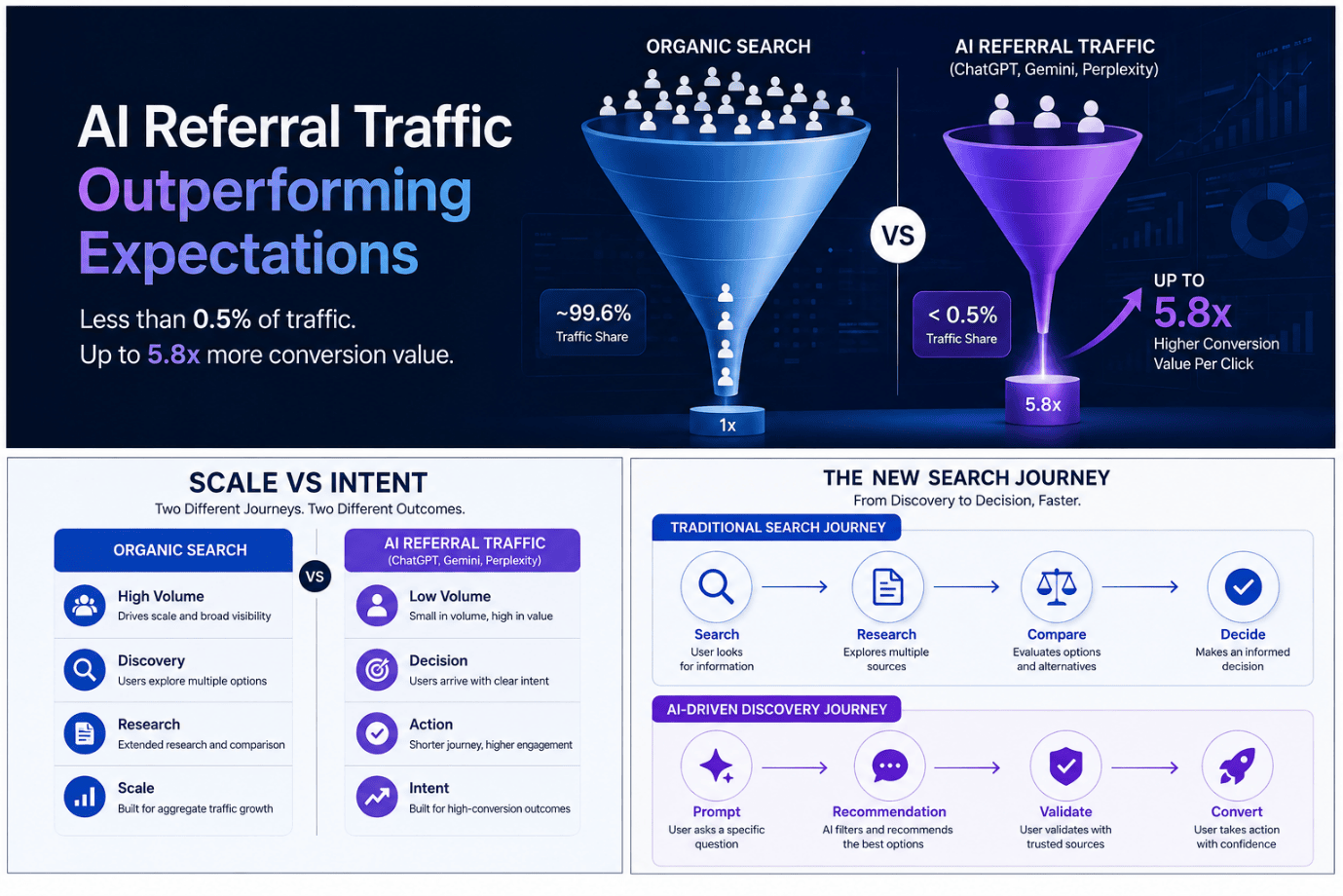
We’ve entered what can be called the Great Decoupling, a phase where visibility and traffic are no longer directly linked. Impressions may still grow, rankings may still hold, but clicks are steadily declining.
Why? Because users are no longer navigating the web, they’re interacting with answers.
What the “Great Decoupling” Really Means
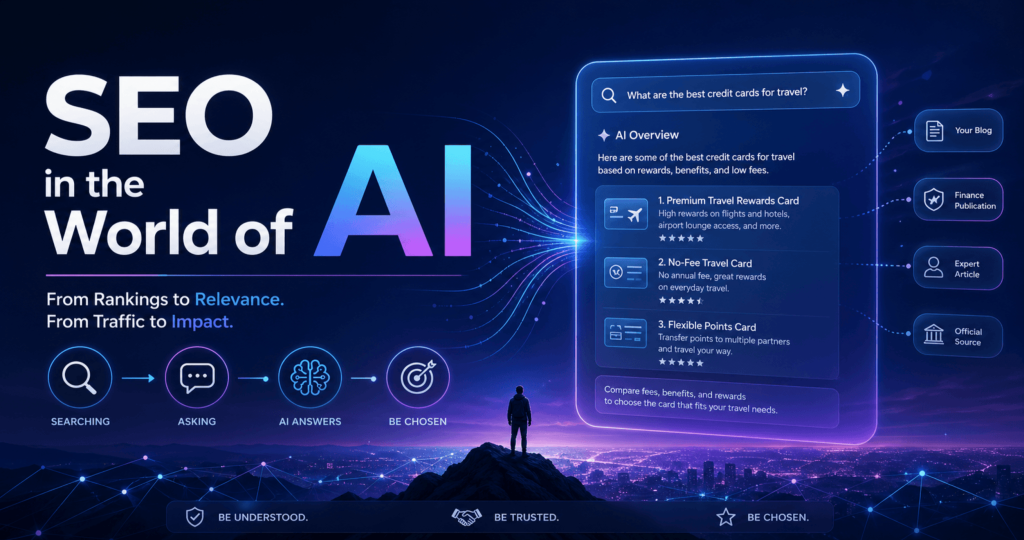
Imagine searching for “best credit cards for travel.”
Earlier:
- You’d see 10 blue links
- You’d compare 2–3 articles
- You’d click, scroll, evaluate
Now:
- You get a summarized list
- Benefits, comparisons, and recommendations are already structured
- Your decision is often made without visiting a single site
This is the decoupling in action.
Your content is still being used—but not necessarily credited with a click.
Which leads to a fundamental shift:
You are no longer competing to be visited. You are competing to be referenced.
Traditional SEO revolved around matching keywords. If your page aligned closely with a search query, you stood a good chance of ranking.
AI has changed that dynamic.
Search engines now interpret:
- Context
- Intent
- Relationships between ideas
This means:
- Repeating keywords is no longer enough
- Surface-level answers are easily ignored
- Content must actually resolve the user’s underlying need
Content must actually resolve the user’s underlying need
For example, someone searching “how to improve credit score” isn’t just looking for tips; they’re looking for clarity, prioritization, and actionable direction. AI systems are trained to identify which content truly delivers that.
Read more about: The Role of AI in Content Creation
Search Results Are No Longer Lists—They’re Compositions
Traditional search ranked entire pages.
AI does something different.
It:
- Extracts specific sections
- Combines insights from multiple sources
- Builds a unified response
Your content is no longer evaluated as a whole page—but as individual units of value.
A single paragraph, definition, or explanation can now compete independently.
This changes how content needs to be written:
- Every section must stand on its own
- Clarity matters more than cleverness
- Completeness beats length
Where Traditional SEO Still Matters
Despite all the change, traditional SEO hasn’t disappeared—it has shifted roles.
Think of it as infrastructure.
Search engines and AI systems still need to:
- Crawl your website
- Understand its structure
- Access your content
Without this foundation:
- Your content won’t be indexed properly
- It won’t be considered for AI-generated responses
The following elements still matter. But they no longer define success; they simply enable participation:
- Site speed
- Clean architecture
- Internal linking
- Basic keyword signals
The New Filters: What Gets Picked by AI
Once your content is accessible, a new layer of evaluation begins.
AI systems tend to prioritize content that demonstrates:
1. Clear Intent Alignment
Does the content fully answer the question, or just partially address it?
2. Depth Without Fluff
Is the explanation complete, or does it leave gaps?
3. Structural Clarity
Can key insights be easily extracted?
4. Consistency of Voice and Authority
Does the content feel reliable, informed, and coherent?
In simple terms:
AI doesn’t reward content that looks optimized. It rewards content that feels useful.
Traffic Is No Longer the Only Outcome
One of the biggest mindset shifts is this:
Visibility doesn’t always lead to clicks anymore.
Your content might influence a decision, shape a user’s understanding, or build brand recall without ever generating a visit. That doesn’t mean SEO is losing relevance; it means its role is expanding. Visibility today isn’t just about clicks; it’s about presence and impact.
Instead of measuring success only through traffic, brands need to think in terms of:
- Presence
- Influence
- Recall
Why Brand Matters More Than Ever
In an AI-driven search environment, brand recognition becomes a powerful signal. When your content appears consistently across platforms, aligns clearly with a specific topic, and builds familiarity over time, it strengthens how both users and AI systems perceive your authority. This consistency makes your content more likely to be trusted, understood, and ultimately selected. AI systems don’t just evaluate individual pages; they recognize patterns. A strong brand creates those patterns.
What Needs to Change Moving Forward
To stay relevant, the approach to SEO needs to evolve:
-
Think Beyond Pages
Focus on ideas, not just articles.
-
Write for Extraction
Structure content so key insights can be easily identified and used.
-
Prioritize Clarity Over Density
Simple, direct explanations perform better than complex writing.
-
Build Topical Authority
Consistency across content matters more than isolated high-ranking pages.
The Future of SEO: From Ranking to Being Chosen.
SEO is no longer a race to the top of a results page; it has become a quieter, more complex challenge of being understood, trusted, and ultimately selected. While rankings still hold value, they are no longer the finish line. In a landscape where answers are generated rather than simply listed, true visibility belongs to those whose content is not just found, but actively used. Read More about: The Science Behind AI Citations: Why Brands Get Picked by AI
Author Bio:
Lalitesh Pawar is a visionary AI Search and Organic Growth Leader at LS Digital, pioneering the evolution from traditional SEO to Generative Engine Optimization (GEO). He crafts cutting-edge strategies that fuse Technical SEO, Programmatic SEO, and Content Strategy to transform search into a powerful, revenue-driving business system. With a sharp focus on making brands the definitive answer in AI-driven ecosystems, Lalitesh combines deep expertise with a forward-thinking approach. He holds an MSc in Digital Marketing from the University of Dundee and is a leading voice on AI’s transformative impact on information discovery.