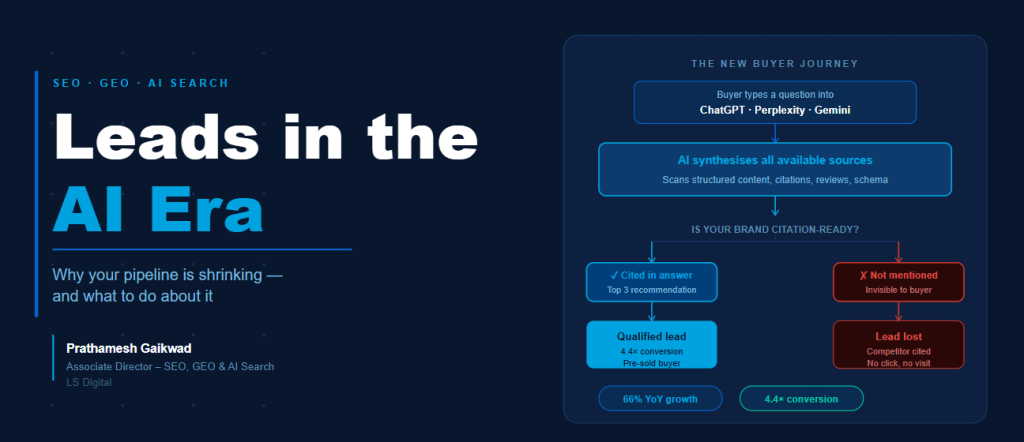
Why your pipeline is shrinking — and what to do about it
Your lead form is still live. Your SEO rankings haven’t collapsed. Yet leads are down. What changed? The answer is not your website – it’s where your buyers are now going before they ever reach it.
In 2024, a marketing manager looking for a travel solution typed a query into Google and scanned ten blue links. In 2025, the same person asked ChatGPT, got a structured answer with three recommended options, and called the one at the top. Your brand either showed up in that answer or it didn’t.
This is the defining shift for B2B and B2C marketers alike. The traditional search to click and click to lead funnel is being compressed, rerouted, and in some verticals, bypassed entirely. At LS Digital, we work across enterprise clients in financial services, travel, technology, and BFSI and what we’re seeing is that visibility in AI-generated answers has become the new first page of the internet. Here’s what the data says, what we’ve observed on the ground and what we need to do about it.
The Numbers Don’t Lie: AI Is Reshaping Discovery
The data from Semrush’s research across 10 million+ keywords and billions of web visits is now clear enough to act on. (All Semrush data referenced in this article is drawn from their publicly available studies – you can explore the full research at semrush.com/blog.)
AI Traffic Is Small – But Punches Way Above Its Weight
- 66% AI referral traffic growth in 2025 (Semrush Traffic & Channel Mix Study)
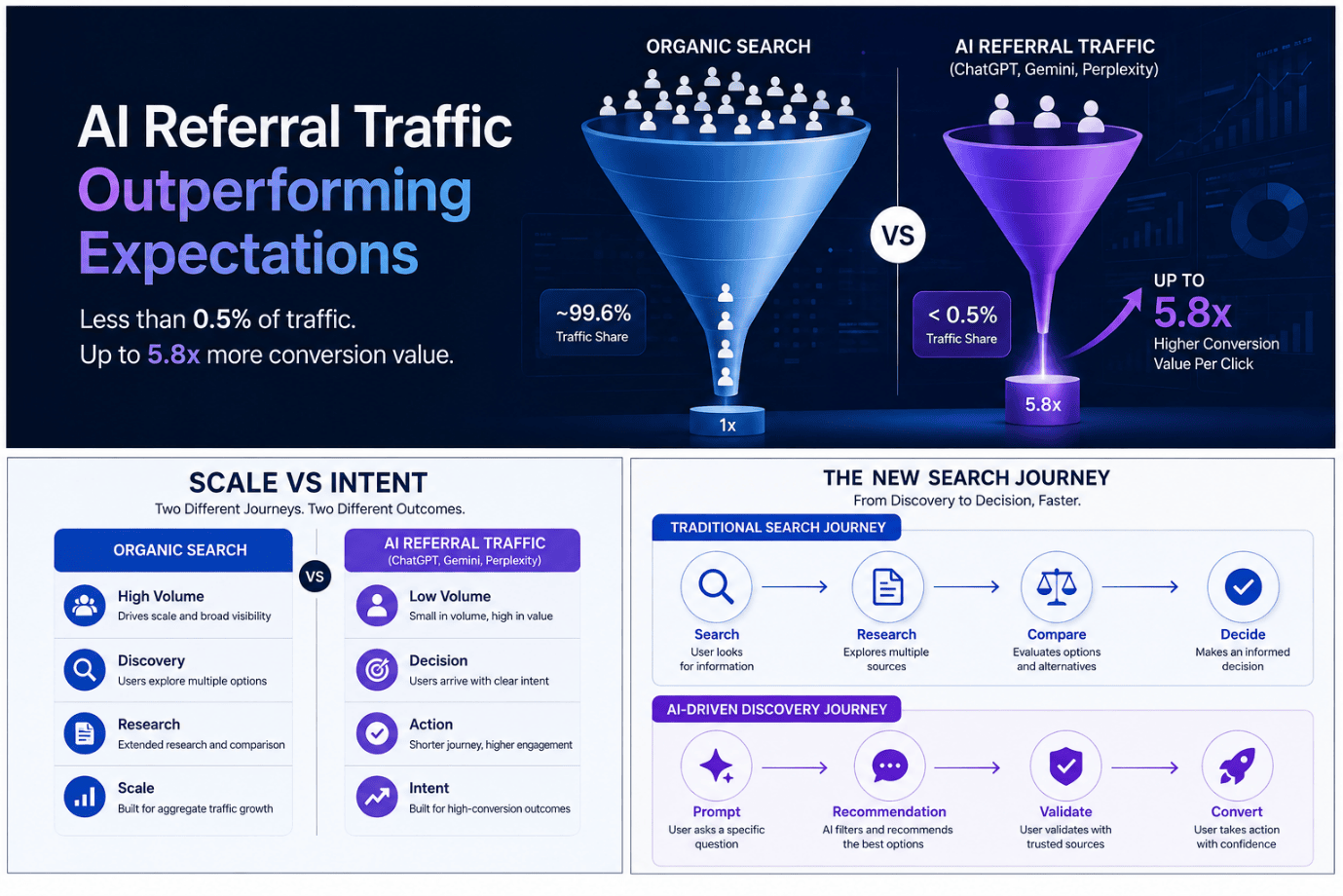
- 4.4× higher conversion rate – AI search visitors vs. traditional organic (Semrush)
- 38% longer session duration for visitors arriving via AI platforms
- 61% of consumers now use AI tools for shopping research (Semrush, Dec 2025)
That 4.4× conversion rate is the headline stat. By the time an AI-referred visitor lands on your site, the LLM has already educated, compared and recommended them. They arrive pre-sold. The catch: if your brand wasn’t in the AI answer, that visitor goes to whoever was.
Honestly? Here’s What We’re Seeing With Our Own Clients
Since early 2025, we’ve tracked AI search impact across client portfolios in financial services, e-commerce, and travel. The pattern is consistent and mirrors the published data with some nuances specific to Indian and GCC markets.
Leads are moving upstream before the click even happens
Across our BFSI clients, direct form fills from organic search have declined even for accounts where rankings have held steady. Why? Decision-making is now happening at the AI answer stage. The visitor who finally lands on the site is already further down the funnel – which is great when your brand is in the AI answer, and a complete miss when it isn’t. There’s no middle ground. The competitor with AI citation presence captures that intent before the user ever clicks anywhere.
Travel: AI is now the first stop for trip planning
When someone asks ChatGPT ‘best platform to book Goa packages under ₹25,000’, the LLM synthesises reviews, editorial content, and community mentions and serves a ranked recommendation before the user visits a single website. We’ve audited these answers across the Indian OTA category and the pattern is consistent: platforms with structured destination content, FAQ-rich itinerary pages, and strong third-party editorial presence dominate the AI shortlist. Brands that lack this content architecture are invisible in the AI answer, regardless of how well they rank on Google.
In B2B, the consideration phase is being compressed
Prospects now arrive at sales conversations already knowing competitive positioning, pricing tiers, and use cases – because an AI told them. The clients whose brand narrative is well-represented in AI citation pools arrive to those conversations with authority already established. Everyone else starts from scratch. When brands earn citations in AI answers, inbound lead quality measurably improves.
AI Shopping: The New Discovery Channel You Can’t Afford to Ignore
Here’s the part that most marketers haven’t fully clocked yet. AI isn’t just influencing decisions – it’s becoming the transaction layer itself. And if you sell products or services online, this changes your lead and conversion strategy fundamentally.
The storefront is shifting into the chat window
In 2025, ChatGPT launched Shopping Research – a feature that lets users explore, compare, and get personalised product recommendations inside the conversation. Ask ChatGPT ‘best laptop under ₹80,000 for video editing’ and it generates a detailed comparison guide with pricing, retailer info, and a recommended pick. No Google. No Amazon. No website visit required.
- 83% of ChatGPT’s shopping carousel data pulls directly from Google Shopping feeds
The new buyer journey: Dialogue with AI → curated recommendation → confirmation → purchase. Your product either shows up in step two or the sale goes to whoever does.
So, What Do You Actually Do About All This?
The framework we use at LS Digital for AI-era lead generation runs across four connected layers – not sequential steps, but parallel signals that reinforce each other. We call it the GEO Foundations Stack.
Layer 1 – AI Hygiene: Get Into the Room First
AI can’t cite what it can’t read. Allow GPTBot, ClaudeBot, PerplexityBot, OAI-SearchBot, and Google-Extended in your robots.txt. Add FAQPage, HowTo, and Product schema. This is table stakes.
Layer 2 – Content AI Actually Wants to Cite (ADEF Framework)
Answer first, context later. Use precise language, back claims with data, add FAQs to every commercial page. Write for intent clusters, not just head keywords.
Layer 3 – E-E-A-T Is Now a Retrieval Signal
LLMs cite sources they trust. Build credentialed author profiles, earn industry coverage, keep pages fresh. If your brand isn’t in the knowledge graph, start there.
Layer 4 – Digital PR: Get Mentioned, Get Cited
The more your brand appears in trade publications, Reddit, YouTube, and cited data studies – the more AI surfaces it. One good proprietary report beats six months of on-page work.
Layer 5 – AI Shopping: Make Your Product Data Agent-Ready
83% of ChatGPT’s shopping results pull from Google Merchant Center. Your Product Listings are now an AI visibility asset. Keep your feed complete, descriptions specific, pricing accurate, schema live on every PDP.
Layer 6 – Measure What Matters: AI Share of Voice
Rank tracking can’t see AI citations. Monitor how often your brand appears in AI answers – that’s your new Share of Voice. Semrush AIO tracks this across ChatGPT, Gemini, Perplexity, and Google AI Mode.
The Lead Generation Playbook Has Changed – Update Yours
The brands generating the most qualified leads right now are not necessarily the ones with the highest domain authority or the biggest content budgets. They’re the ones that understood earliest that AI systems have become the new trusted advisor in the buyer journey and built their presence accordingly.
The opportunity is still wide open. AI search is growing at 66% year-on-year but still represents less than 0.15% of total web traffic. That gap closes rapidly and the brands that establish citation authority now will be structurally advantaged when the inflection point arrives.
At LS Digital, our GEO practice brings together technical SEO, content strategy, Digital PR, and brand monitoring. If you’re curious about where your brand stands in AI search today, we’re happy to walk you through it.
Author Bio:

Prathamesh Gaikwad is Associate Director – SEO, GEO & AI Search at LS Digital, leading AI-driven search programmes across enterprise accounts in India, UAE, and UK. He specialises in Generative Engine Optimization, E-E-A-T strategy, and AI search monetisation.
Linkedin