
Imagine spending months improving your Google rankings, only to discover that when a customer asks ChatGPT for a recommendation, your brand isn’t even mentioned. That’s the reality many businesses are facing today. AI search is changing how people discover brands, and traditional SEO success no longer guarantees visibility.
Ranking on Google no longer means you exist everywhere your customers are looking. AI platforms like ChatGPT, Gemini, Claude, and Perplexity are quickly becoming a first stop for research, and they don’t always pull from the same sources Google ranks first.
What Is an LLM Audit?
An LLM audit evaluates whether your brand can be discovered, understood, and cited by AI assistants like ChatGPT, Gemini, Claude, and Perplexity, the platforms where people increasingly ask for a recommendation instead of typing a search query. Where a traditional SEO audit focuses on ranking in a list of links, an LLM audit focuses on whether your brand becomes the source an AI model chooses to reference when it answers a question.
AI-powered search systems use retrieval, ranking, relevance, authority, and other signals to determine which sources may be useful for generating an answer. An LLM audit exists to evaluate your brand against exactly these signals, rather than the ones a traditional search engine looks for.
Before going further, it’s worth being clear about what this process isn’t — mainly because the term “LLM audit” is being used loosely across the industry right now. An LLM audit is not a technical SEO audit with a new name. Technical SEO makes sure search engines can crawl and rank your pages; an LLM audit goes further to evaluate whether AI systems can understand, trust, and choose to cite your content. It’s also not a guarantee of AI citation — no audit, agency, or checklist can promise your brand will show up in a ChatGPT or Gemini response, because AI platforms generate answers dynamically and citations shift with every query and every model update. And it isn’t complete once you’ve added an llms.txt file or implemented schema markup. Those are useful technical steps, but they’re single tactics within a much broader evaluation of content quality, authority, and measurement — not the audit itself.
When Ranking Well Isn’t Enough Anymore
This is becoming a common challenge as AI-powered search continues to grow.
According to SparkToro (2025), AI-driven search now accounts for around 13% of all web searches, and adoption continues to increase. At the same time, millions of people use AI assistants every day to research products, compare solutions, and find answers before visiting a website.
Research from DerivateX (2026) also found that visitors arriving from AI platforms showed higher conversion rates than traditional organic traffic in their study. While results will vary by industry, it highlights why AI visibility is becoming an important part of modern SEO.
If your brand isn’t appearing in AI-generated responses, publishing more content alone is unlikely to solve the problem. The first step is understanding whether AI systems can discover, understand, and trust your content enough to reference it.
Also Read – The Science Behind AI Citations: Why Brands Get Picked by AI
Why Your Regular SEO Audit Doesn’t Catch This
Traditional SEO audits are designed to answer questions like:
- Can search engines crawl the page?
- Is the page indexed?
- Is it technically optimized to rank in Google?
Those checks are still essential, but AI platforms evaluate content differently.
Instead of focusing only on rankings, large language models assess whether a page provides a clear, trustworthy, and well-structured answer that can be confidently included in a response. They look for content that’s easy to understand, backed by credible sources, and written in a way that can be accurately summarized.
This explains why a page ranking first on Google isn’t always the one referenced by AI tools.
For example, Ahrefs (September 2025) found that ChatGPT frequently cited pages ranking beyond Google’s first page. The study suggests that traditional rankings alone are not the deciding factor for AI citations. Content quality, structure, authority, and clarity all play an important role in whether your brand gets mentioned.
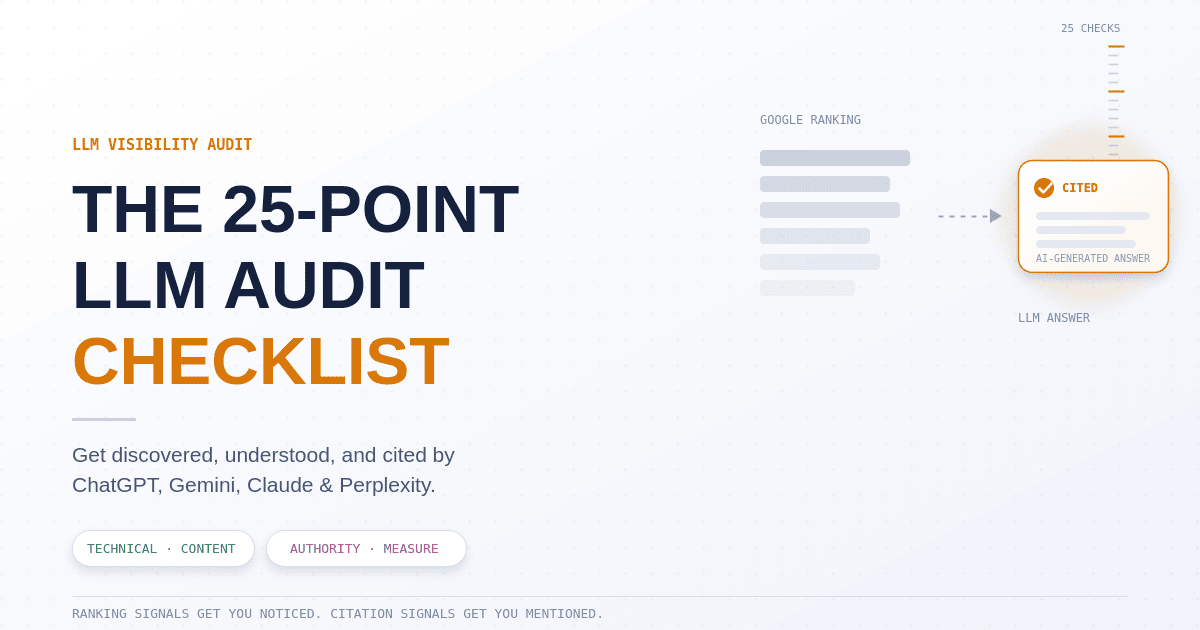
That’s why an LLM audit goes beyond traditional SEO. It evaluates not only whether your content can be found, but also whether AI systems can understand it, trust it, and confidently include it in their responses. In short: ranking signals get you noticed by Google, while citation signals get you mentioned by AI — and a proper audit has to check both.
Two concepts sit underneath this evaluation. The first is entity understanding — how clearly AI systems can identify who your brand is, what it does, and how it’s positioned relative to competitors, based on how consistently that information appears across the web. The second is citation gap analysis — mapping the specific queries and topics where competitors are already being cited by AI platforms and your brand isn’t, so effort goes toward closing the gaps that matter most.
The 25-Point LLM Audit Checklist
Think of technical fixes as unlocking the front door. If AI can’t enter your website, it never gets a chance to evaluate your content. Work through the checklist below in that order — technical access first, then content, authority, and measurement.
| # | Audit Item | Category |
|---|---|---|
| 1 | Ensure robots.txt does not block major AI crawlers (GPTBot, ClaudeBot, PerplexityBot, OAI-SearchBot, Google-Extended where applicable) | Technical |
| 2 | Verify key pages are fully accessible in HTML without relying on JavaScript to display core content | Technical |
| 3 | Check that your CDN, WAF, or bot protection isn’t blocking AI crawlers | Technical |
| 4 | Consider implementing an llms.txt file to help AI systems discover important content | Technical |
| 5 | Confirm your key pages are indexed in both Google and Bing | Technical |
| 6 | Implement structured data such as Organization, Article, FAQ, HowTo, Product, Service, and Breadcrumb where relevant | Technical |
| 7 | Ensure important pages pass Core Web Vitals and load quickly | Technical |
| 8 | Place the primary answer within the first 100 words of the page | Content |
| 9 | Add a TL;DR or Key Takeaways section to long-form content | Content |
| 10 | Include FAQs that answer real customer questions | Content |
| 11 | Support claims with credible data, research, and attributed sources | Content |
| 12 | Use numbered steps, bullet points, tables, and other structured formats where appropriate | Content |
| 13 | Clearly explain technical terms and expand acronyms on first mention | Content |
| 14 | Display publish and last updated dates on important pages | Content |
| 15 | Write descriptive headings that answer user questions and improve readability | Content |
| 16 | Maintain complete and up-to-date profiles on relevant review platforms such as G2, Capterra, or Trustpilot | Authority |
| 17 | Build brand mentions in trusted third-party publications and comparison articles | Authority |
| 18 | Keep author and leadership profiles updated with expertise and professional credentials | Authority |
| 19 | Build an authentic presence on relevant communities like Reddit, Quora, GitHub, or industry forums | Authority |
| 20 | Maintain consistent brand messaging, category, and value proposition across all digital channels | Authority |
| 21 | Earn backlinks from reputable websites that are frequently referenced within your industry | Authority |
| 22 | Establish a baseline by checking how your brand appears in ChatGPT, Gemini, Claude, Perplexity, and other AI platforms | Measurement |
| 23 | Track AI referral traffic separately in GA4 or your analytics platform | Measurement |
| 24 | Create an AI Visibility Score to measure mentions, citations, and share of voice over time | Measurement |
| 25 | Monitor a consistent set of prompts every month to measure changes in AI visibility | Measurement |
The LLM Audit: What to Actually Check
Now that you have the checklist, the next step is understanding why each area matters. Not every recommendation has the same impact, so it’s important to focus on the fundamentals before moving on to content and authority.
Think of the audit in four stages: Technical Foundation, Content Structure, Authority Signals, and Measurement. Each stage builds on the previous one, helping AI platforms discover, understand, and reference your content more effectively.
1. Technical Foundation
Before AI platforms can reference your content, they first need to access it. Even the best-written article won’t appear in AI-generated answers if crawlers can’t read or understand your pages.
If AI crawlers can’t access your website, they can’t read or cite your content — no matter how good it is.
What to check
- Robots.txt — Review your robots.txt file to ensure it isn’t blocking AI crawlers such as GPTBot, ClaudeBot, PerplexityBot, OAI-SearchBot, or Google-Extended, where applicable. It’s common for staging or migration rules to accidentally block these user agents. For example, a rule like “Disallow: /blog/” left over from a staging migration can silently block GPTBot from your entire blog — the exact content you’d want AI to cite.
- HTML Accessibility — Many modern websites rely heavily on JavaScript, but some AI crawlers still prefer content that’s available directly in the HTML. Check your page source to confirm that important elements like the title, H1, introductory content, and key information are visible without requiring JavaScript.
- CDN and Bot Protection — If you use services such as Cloudflare, Akamai, Fastly, or Imperva, review your security settings to ensure legitimate AI crawlers aren’t being blocked or challenged by bot protection rules.
llms.txt — Although llms.txt is still evolving as a standard, it’s worth considering as part of your AI strategy. It helps organize important content for AI systems and may become more widely adopted over time. - Search Engine Indexing — Google indexing alone isn’t enough. Since several AI-powered search experiences also rely on Bing, verify that your important pages are indexed in both search engines using Google Search Console and Bing Webmaster Tools.
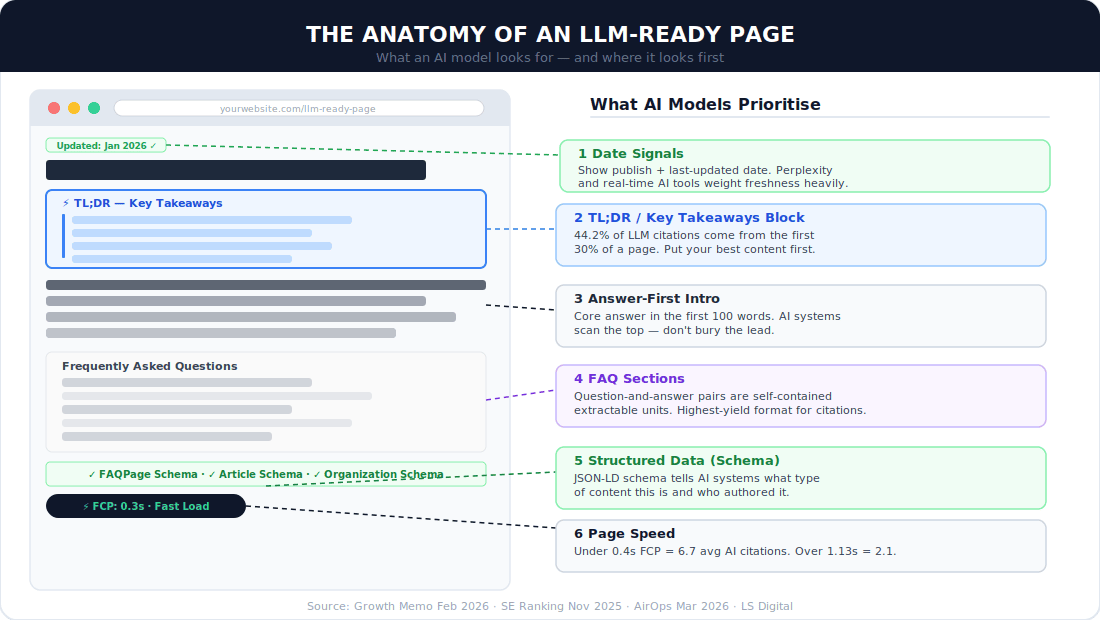
- Structured Data — Structured data helps search engines and AI systems understand your content more effectively. Implement relevant schema such as Organization, Article, FAQ, HowTo, Product, Service, Person, and Breadcrumb, depending on the page type. According to Rankio’s study of more than 10,000 AI citations, websites with well-implemented structured data were more likely to be referenced in AI-generated responses.
- Page Experience — Fast-loading pages improve both user experience and accessibility for AI crawlers. Instead of targeting a single performance metric, aim to pass Core Web Vitals and regularly review your important pages in PageSpeed Insights.
2. Content Structure
Getting crawled doesn’t guarantee getting cited.
AI platforms scan multiple pages before deciding which information to include in a response. Content that is clear, well-organized, and easy to understand has a better chance of being referenced.
Even when AI can access your content, it still has to make sense of it quickly. Clear, well-organized pages are what let AI systems pull an accurate answer instead of skipping your page for a competitor’s.
What to check
- Answer the Main Question Early — A February 2026 Growth Memo analysis found that 44.2% of observed LLM citations came from the first 30% of page content. Rather than spending several paragraphs on background information, answer the user’s primary question within the opening section and then expand on the topic.
- Add a TL;DR Section — For longer articles, include a short summary near the beginning. A concise list of key takeaways helps readers quickly understand the topic and makes it easier for AI systems to identify the most important information.
- Include FAQs — FAQs mirror the way people naturally ask questions. Add relevant questions that reflect customer intent and, where appropriate, support them with FAQ schema.
- Support Your Claims — Whenever you share statistics, research, or industry insights, include the original source. Referencing credible data strengthens trust and gives AI systems greater confidence in the information they’re using.
- Use Structured Formatting — Break complex topics into numbered steps, bullet points, comparison tables, and checklists wherever appropriate. Well-structured content is easier for readers to follow and easier for AI systems to interpret.
- Show Freshness — Display both the publish date and last updated date on important pages. This helps readers understand how recent the information is and demonstrates that the content is being maintained.
- Write Helpful Headings — Instead of generic headings like “Features” or “Benefits,” write headings that reflect the questions your audience is asking.
❌ Enterprise Features
✅ How does the platform protect customer data?
Question-based headings provide clearer context for both readers and AI systems.
3. Authority Signals
Technical SEO and content quality help AI platforms discover your content. Authority helps them decide whether your content is trustworthy enough to reference.
Building authority takes time, but it’s one of the strongest long-term investments you can make for AI visibility.
>AI systems don’t just need to find your content — they need a reason to trust it. Authority signals are what tell AI whether your brand is a credible source worth citing.
What to check
- Maintain Entity Consistency — Your website, LinkedIn profile, review sites, and third-party mentions should describe your company consistently. Keep your brand name, category, products, and value proposition aligned across platforms so AI systems can confidently associate them with the same organization.
- Optimize Review Platform Profiles — Platforms such as G2, Capterra, and Trustpilot are frequently referenced for software and service-related searches. Make sure your company profile is complete, accurate, and aligned with the messaging on your website. For example, two competing SaaS tools may offer nearly identical features, but the one with a complete, recently updated G2 profile is more likely to be the one an AI assistant recommends.
- Earn Third-Party Mentions — AI platforms often reference independent sources alongside company websites. Being featured in comparison articles, industry reports, and reputable publications can strengthen your credibility.
- Keep Author Profiles Updated — Ensure founders, subject matter experts, and content authors have complete and up-to-date LinkedIn profiles that clearly demonstrate their expertise.
- Participate in Industry Communities — Contribute helpful answers on platforms like Reddit, Quora, GitHub, or other relevant communities. Focus on providing value rather than promotional content.
- Build High-Quality Backlinks — Rather than chasing a high volume of backlinks, focus on earning links from trusted industry websites. Review which domains frequently appear in AI-generated responses within your niche and prioritise outreach to those publications.
Also Read – AI Search in 2026
Where to Start
You don’t need to implement all 25 recommendations at once.
Start by strengthening your technical foundation so AI platforms can access and understand your content. Once that’s in place, improve your content structure to make key information easier to find and reference.
Next, invest in authority signals by building your brand presence across trusted websites, review platforms, and industry communities. These efforts take time, but they create long-term credibility.
Finally, establish a measurement framework from day one. Tracking citations, AI referral traffic, and prompt visibility will help you understand what’s working and where further optimization is needed.
Traditional SEO remains the foundation of online visibility, but AI search introduces a new layer of optimization. By combining strong technical SEO, well-structured content, trusted authority signals, and ongoing measurement, you’ll be in a much stronger position to improve your visibility in AI-generated search experiences.
Ready to See Where You Stand in AI Search?
At LS Digital, our LLM audit evaluates your brand across four critical dimensions:
Technical Accessibility > Content Readiness > Authority & Entity Signals > AI Visibility & Measurement
We identify where your brand is being mentioned and cited, where competitors are winning visibility, and what is preventing your content from becoming a trusted AI source.
The outcome is more than an audit. It’s a prioritised roadmap for improving your visibility across AI-powered search experiences.
Want to know where your brand stands? Get in touch, and let’s find out.
Author Bio –

Akshay Jadhav is Manager – SEO at LS Digital, with 7+ years of experience in driving organic growth for leading brands. He specializes in SEO, GEO (Generative Engine Optimization), and AI-powered search, helping businesses strengthen their visibility across traditional search engines and emerging AI platforms.
Linkedin – https://www.linkedin.com/in/akshay-u-jadhav/