
1.How is conversational AI changing search traffic for small publishers?
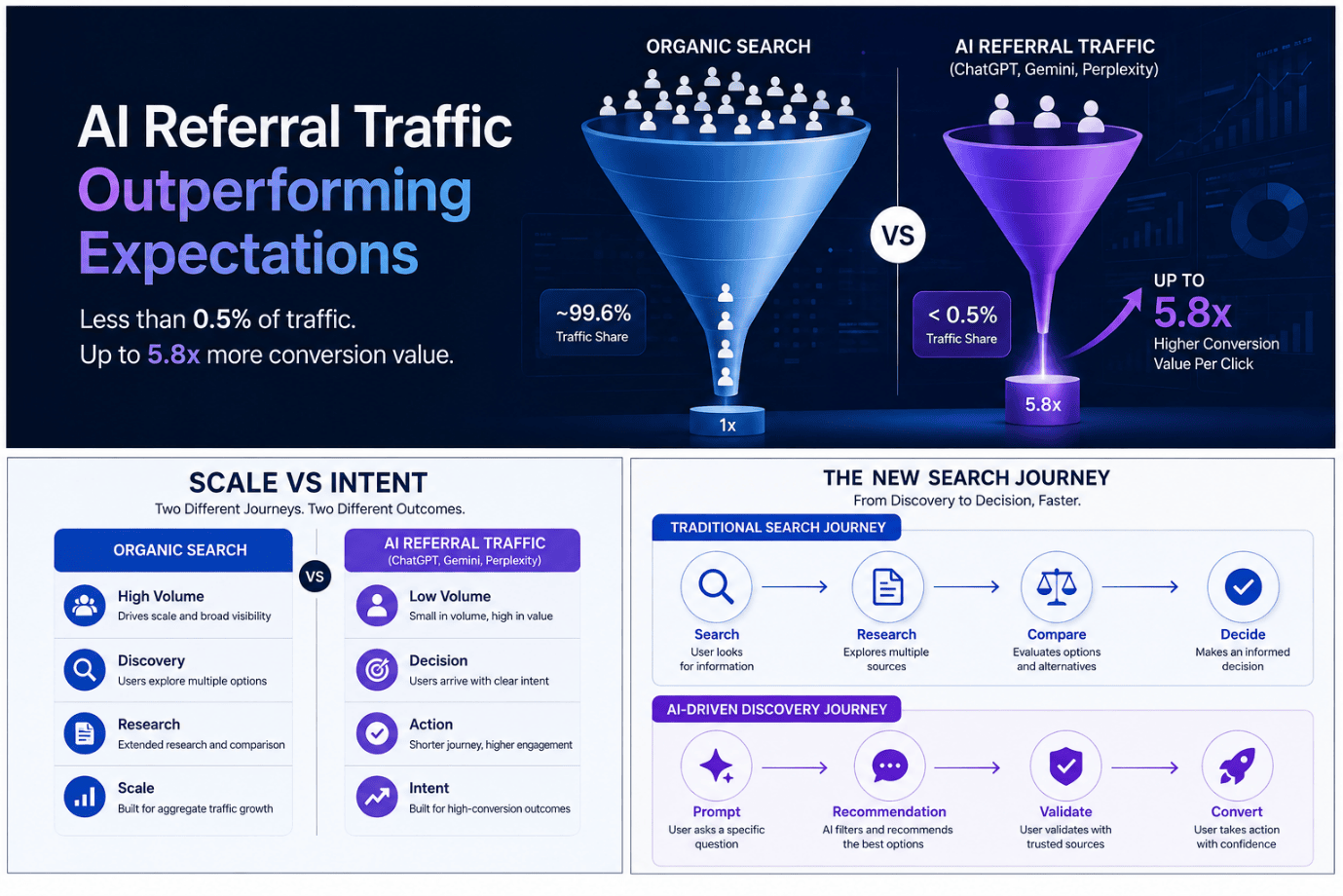
Conversational AI is sharply reducing website visits for publishers by answering user queries directly, cutting off the traditional search-to-click journey and leading to major drops in traffic and revenue. As a result, success is shifting from ranking on search results to being a trusted, cited source within AI-generated answers, making credibility and visibility inside these systems more important than sheer clicks. [Source: Exchange4Media]
2. AI won’t replace marketers; it will replace marketing operating models
AI is portrayed not as a replacement for marketers, but as a force that will fundamentally reshape how marketing functions operate, shifting focus from traditional structures to more agile, data-driven models. The key change lies in transforming workflows, decision-making, and collaboration, requiring marketers to adapt their skills and mindset to work alongside AI-enabled systems rather than compete with them. [Source: Campaign India]
3. Inbound or outbound? How to incorporate both into your B2B lead generation strategy
Relying only on inbound or outbound lead generation can limit B2B growth, so businesses need a balanced strategy that combines both to keep a steady pipeline. Inbound attracts prospects through content and awareness, while outbound proactively reaches targeted leads, and when integrated effectively, each amplifies the other’s impact. The ideal mix depends on the audience, but aligning both with the buyer journey, intent data, and personalization leads to stronger conversions and sustainable results. [Source: Miami Herald]
4. Why India continues to be Meta’s biggest untapped market
India is central to Meta’s growth due to its massive user base and deep engagement, even though revenue per user remains low compared to global markets. The country’s scale, low ad costs, and unmatched ecosystem across Facebook, Instagram, and WhatsApp keep advertisers heavily reliant on Meta, while future monetisation is expected to rise as user growth stabilises and competition for ad space increases. [Source: Pitch]
5. Agencies are moving closer to supply, and it’s reshaping the programmatic middle layer
Agencies are increasingly trying to control more of the digital advertising ecosystem—moving beyond media buying to own data, identity systems, and the tech infrastructure behind how ads are delivered. This shift is reshaping the traditional “middle layer” of programmatic advertising, reducing reliance on intermediaries and giving agencies more direct influence over supply and performance. [Source: Digi Day]
6. Designing for engagement: 5 reasons why UX matters more than features in media apps
In media apps, success depends less on adding more features and more on delivering a seamless, intuitive user experience that keeps users engaged and returning. Simple design, strong first impressions, easy navigation, fast performance, and emotional connection all play a critical role in shaping how users interact with and value an app. [Source: Best Media Info]
7. Is CX Really the Revenue Driver We’ve Touted for a Decade?
Customer experience (CX) is often measured using efficiency metrics like AI deflection, but these fail to capture real business impact such as customer satisfaction, retention, and revenue. The article highlights how fragmented “bolt-on” AI systems can worsen experiences, while unified, goal-driven AI with full customer context can actually improve outcomes and reduce costs. Ultimately, organizations should shift toward measuring CX based on its direct influence on retention and revenue, building data-driven proof to align with business goals. [Source: CMS Wire]
8. How signal decay hurts your top-of-funnel performance
Signal decay is causing marketers to lose critical conversion data due to privacy changes, ad blockers, and cross-device behavior, making top-of-funnel campaigns appear less effective than they actually are. This often leads to reduced budgets and a negative cycle where customer acquisition declines. Improving data quality through better tracking methods like enhanced conversions, offline data, and micro-conversions can help restore visibility and optimize campaign performance. [Source: Search Engine Journal]
9. The Hidden Engine of Modern Marketing
Marketing effectiveness today depends less on adding more tools and more on how well data is unified and activated to deliver timely, relevant customer experiences. A strong “middle layer” of decisioning and orchestration helps connect strategy to real behavior, enabling consistent, context-driven interactions and measurable outcomes. With growing AI adoption and expanding martech stacks, brands that optimize this core can move from fragmented campaigns to responsive, ROI-driven customer journeys. [Source: AD Week]
10. Influencer marketing: How ad holding companies are building creator empires
Influencer marketing is rapidly becoming central to advertising as major holding companies like Publicis, WPP, and Dentsu build integrated, data-driven creator ecosystems powered by AI, commerce, and measurement. These firms are moving beyond simple collaborations to own end-to-end influencer infrastructure, embedding creators into media planning and linking campaigns directly to business outcomes. As a result, the industry is shifting toward scalable, performance-focused models where creators function as a core, measurable marketing channel. [Source: StoryBoard18]