1.The clean slate advantage: Why legacy is becoming a strategic risk in the AI era
AI is shifting competition from simply upgrading old systems to completely redesigning businesses around intelligent, adaptive models. Companies without legacy systems can build AI-native operations from scratch, making them faster, more flexible, and more customer-centric. Meanwhile, traditional enterprises risk falling behind if they keep layering AI onto outdated architectures instead of rethinking their entire structure. [Source: Social Samosa]
2. Claude Design vs Google Stitch: Which AI Designs Better Website Prototypes?
AI is reshaping customer service by shifting it from reactive problem-solving to proactive, predictive support that improves efficiency, reduces costs, and enhances customer satisfaction. It is rapidly becoming essential across industries, with businesses adopting advanced technologies to automate interactions and scale operations in both B2C and B2B environments. However, its success depends on strong data systems and aligning implementation with clear business objectives rather than treating it as just a technology upgrade. [Source: Fortune]
3. Vibe Marketing: A Declaration Of Independence From The Martech Machine
Marketing is evolving toward “vibe marketing,” where AI takes over execution tasks like campaign creation, targeting, and optimization, allowing marketers to focus on strategy, brand building, and understanding customer needs. While this shift reduces dependence on complex martech systems and boosts efficiency, it also raises concerns around trust, authenticity, and brand safety, making human oversight essential to ensure meaningful and credible engagement. [Source: Forbes]
4. Agentic AI’s compute demands are growing faster than anyone projected
Agentic AI consumes far more compute than traditional chatbots because it performs multi-step tasks, repeatedly processes growing context, and can use up to 1,000x more tokens per request, making each interaction significantly heavier. This is forcing data centers to redesign their infrastructure, shifting chip usage, increasing reliance on CPUs alongside GPUs, and driving higher power consumption and operational costs. [Source: Quartz]
5. Why GEO could matter more than SEO in the AI era
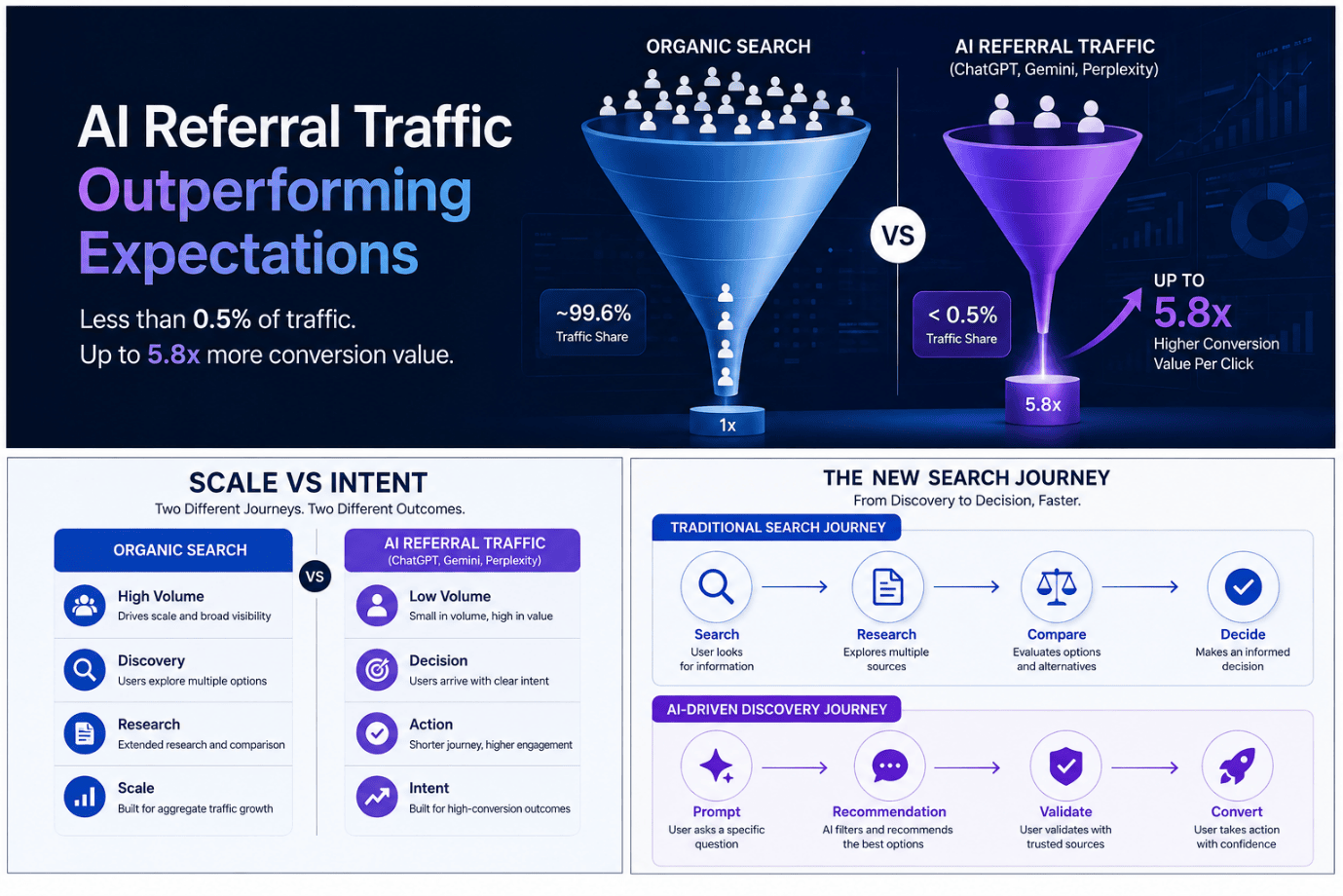
Consumer behavior is shifting from traditional search to AI tools like ChatGPT and Google AI Overviews, where answers are generated directly, reducing clicks and making even top-ranked websites lose traffic and leads. This shift makes GEO (Generative Experience Optimization) critical, as AI models now decide which brands are recommended based on trust signals rather than search rankings, meaning brands must ensure they are visible within AI-generated responses to stay relevant [Source: ET Insight]
6. AI is no longer changing only campaigns, but also the way marketing measures success
Marketing measurement is shifting from simply evaluating past campaign performance to using AI, data, and creative insights to optimise decisions in real time, with a stronger focus on business outcomes rather than reach or impressions. The industry is moving toward AI-driven decision systems and “creative intelligence,” though challenges like data transparency, lack of unified measurement models, and integration across platforms still limit a complete view of performance. [Source: Media Marketing]
7. Why Your AI Ad Strategy Is Only As Good As Your Data
AI-driven ad platforms are becoming the default in marketing, but their performance depends heavily on the quality of data and signals fed into them. Strong first-party data, clear business goals, and human strategy lead to better outcomes, while poor inputs simply accelerate inefficiency and wasted spend. Ultimately, marketers must actively guide and validate automation rather than rely on AI alone, as it amplifies strategy rather than replacing it. [Source: Search Engine Journal]
8. Stop Treating AI Visibility As One Problem. It’s Actually Three, On Three Different Layers
AI visibility isn’t a single issue but operates across three layers: retrieval (whether AI can access your content), knowledge graphs (how clearly your brand is defined as an entity), and context graphs (how AI agents interpret your brand within real-world decision environments). The article argues most marketers over-focus on content creation for retrieval, while neglecting entity clarity and upstream data consistency, which ultimately determine how AI systems recognize and recommend a brand. [Source: Search Engine Journal]
9. Microsoft Advertising expands LinkedIn profile targeting to CTV
Microsoft Advertising has introduced LinkedIn profile targeting to connected TV (CTV), allowing advertisers to reach audiences on streaming platforms using professional data like industry, job function, and company. This helps bring more precise B2B targeting to a channel that traditionally focused on broad reach, improving how brands connect awareness campaigns to measurable outcomes. [Source: Search Engine Land]
10. Practical Interface Patterns For AI Transparency
Traditional loading indicators like spinners don’t work well for AI systems because they hide what the system is actually doing, which can confuse users and reduce trust; instead, the article suggests using interface patterns that clearly show the AI’s thinking process, steps, and decisions. New patterns like dynamic checklists, live progress updates, and audit trails—combined with clear, specific status messages—help users understand how the AI is working and build confidence in its outputs. [Source: Smashing Magazine]